
EOR vs Setting Up a Foreign Entity: Which Is Better for Global Expansion?
Being able to tap into new resources, such as international talent pools and markets, is an incredibly powerful growth accelerator for modern companies. However, as soon as the decision is made to expand into new markets by hiring internationally, the following question is inevitably raised: Should the business set up a foreign legal entity, or should it use EOR services?
Both options enable companies to hire employees in new markets in fundamentally different ways. As such, making the right decision can greatly affect the rate at which expansion is achieved, the cost of expansion, and the complexity of expansion.
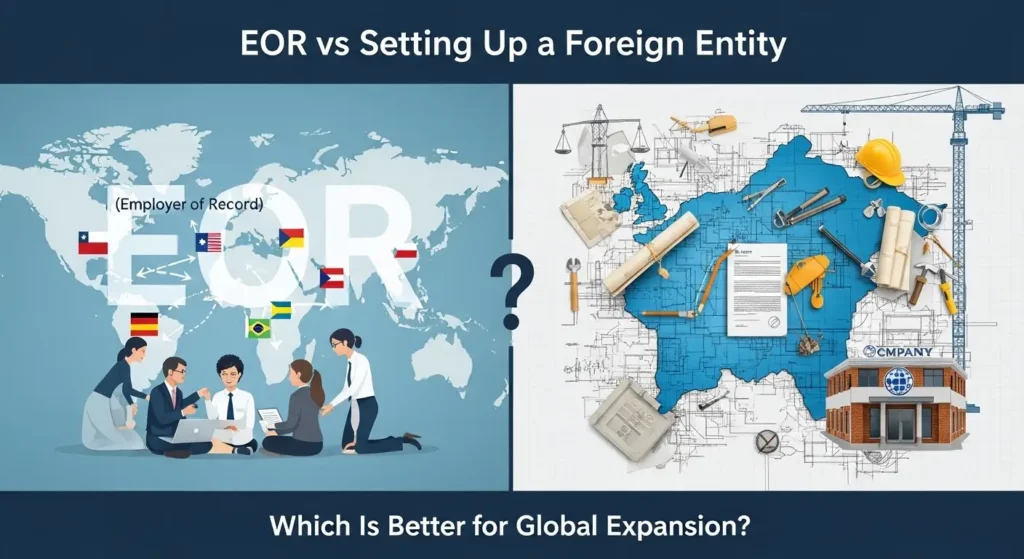
In many modern companies, especially in remote-first companies and fast-growing startups, the decision between the two is often an exercise in balancing complexity. It’s all about choosing the right Global Human platform, like Multiplier, that can assist businesses in their growth by providing the best Employer of Record services.
Key Takeaways
- Deciding whether to use an EOR or a foreign entity depends on various factors, including expansion objectives, scale of hiring, and complexity of operation.
- An EOR facilitates companies in hiring international staff within 48 hours without having to open legal entities in those countries.
- Forming a foreign entity, on the other hand, provides businesses with full control at a higher cost, including legal formalities.
- Global hiring is subject to many labour laws, as well as payroll complexities, making compliance one of the most important aspects for businesses looking to expand.
- Global Human Platforms like Multiplier allow businesses to hire, manage, and pay their teams in over 150 countries using its owned entity network.
How Can Businesses Hire Employees in Other Countries Without Setting Up an Entity?
Hiring someone in another country usually requires a company to have a legal presence there. This is where an Employer of Record (EOR) becomes useful. The EOR services act as the legal employer on paper, while the employee works for your company. They handle employment contracts, payroll, and compliance according to local laws. This makes global hiring much easier, especially for companies that want to expand internationally without setting up a new entity in every country. Global employment platforms like Multiplier help companies hire and pay employees in over 150 countries through its owned entity network. This way, the company will be able to focus on its growth and the expansion into new countries.
Why Do Companies Use an EOR for Global Expansion?
For businesses that need to scale up quickly, an EOR can be a huge time-saver when it comes to entering international hiring. Businesses no longer need to go through the time-consuming process of setting up a legal entity. They can hire international staff within streamlined hiring cycles. Some of the key advantages of hiring an EOR include:
- Faster Hiring Cycles- Businesses can hire international staff within 48 hours, as opposed to months.
- Less Administrative Burden- The legal obligations of hiring staff rest with the EOR provider.
- Compliance with Local Regulations- Contracts, taxes, and benefits will be in compliance with local regulations.
- Less Initial Investment- Businesses do not need to invest heavily in setting up a legal entity.
When Should Companies Choose an EOR Instead of an Entity?
Businesses can consider working with an EOR when:
- They want to test a new market before committing to a full business presence.
- They need to hire remote employees in different countries quickly.
- They want to avoid complicated legal and administrative processes.
- They plan to build global teams without opening physical offices.
For companies that value flexibility and speed, an EOR can be a practical way to expand while staying focused on their core business goals.
What Does Setting Up a Foreign Entity Involve?
Creating a foreign entity involves establishing a local legal business entity in another country. This allows the company to hire employees directly. Although the approach gives the company full control, there are some administrative and regulatory requirements that need to be fulfilled, and these may take some months. Some of the general requirements include:
- Registration of the company with the authorities
- Opening bank accounts in a foreign country
- Arranging for tax registrations and payroll systems
- Engaging legal and accounting professionals
- Ensuring compliance with labour laws
Each country has its own set of financial regulations, and businesses must spend considerable time and effort understanding these regulations before the hiring process can begin.
What Are the Benefits of Setting Up Your Own Entity?
Even though EORs provide ease of operation and speed, the creation of a legal entity might still be desirable in some cases. Businesses that intend to operate for an extended period in the host country or intend to employ numerous employees might consider the benefits of having their own entity. Some of the benefits that can be derived from owning an entity in another country include:
Total control over the operation of the business
Employment relationship with the employees of the host country
Flexibility in the design of the compensation system
Presence in the foreign market
How Does Compliance Work in Each Approach?
One of the most difficult aspects of hiring internationally is compliance. Each country has unique laws regarding hiring, taxes, and labor laws. If a company is setting up its own entity in another country, it is its responsibility to understand and comply with all the laws, which can be quite complex.
This is where an EOR can be very helpful, making it much easier for a company to comply with laws. Global Human Platforms like Multiplier help companies stay compliant with local labour laws, payroll requirements, and employment regulations while hiring internationally. It has a framework that assists companies in managing all the requirements that need to be adhered to when it comes to international hiring.
Which Option Is More Cost-Effective for Global Hiring?
Cost factors are significant in deciding between EOR and a foreign entity. Establishing an entity involves certain costs, including legal registration costs, compliance costs, accounting costs, and administrative costs. For businesses that require only a few employees in a country, these costs may become challenging for them to afford.
The EOR model offers flat, transparent pricing and a 35% lower total cost of ownership for the business. The cost of hiring through an EOR is usually the service fee paid to the provider for the management of employment, payroll, and compliance. This helps the company expand into new markets without investing heavily in the initial stages of growth.
Conclusion
By forming a company in another country, a business gains full control over its operations in that country. This, however, takes a lot of time, and a series of steps is followed in the process. Many companies instead choose to work with an Employer of Record, such as Multiplier. This allows businesses to hire and manage employees in other countries more easily, while keeping the flexibility needed for smooth global expansion.
With Multiplier, companies can expand globally without the usual operational hurdles. This is because it is a precision-built Global Teams Platform that helps companies hire, manage, and pay people across 150+ countries using its owned entity network. Global payroll and human-first support available 24/7, companies can scale without worrying about complexity.
FAQs
1. What is the main difference between EOR and setting up a foreign entity?
The main difference between EOR and setting up a foreign entity is that EOR helps the company hire employees in another country without the need for the company to establish a legal entity in the new country. On the other hand, setting up a foreign entity involves establishing a legal entity in the new country and handling all the legal, administrative, and employment aspects of the company on your own.
2. When should a company consider setting up a foreign entity instead of using EOR?
A company should consider setting up a foreign entity when it is planning long-term operations in a specific country or when it is looking to hire a large workforce in the new country.
3. Can a startup employ the help of an EOR to hire global employees?
Yes, employing the help of an EOR is quite common for a startup that wishes to expand globally. This will enable the startup to employ the best talent from various parts of the world without having to invest months in setting up a legal entity. This is particularly relevant for a startup that wishes to explore new markets and is looking for flexibility in the process.
4. How does an EOR help businesses comply with international employment laws?
An EOR will help the business comply with the various international employment laws. This is because employment laws vary significantly between countries. Thus, the EOR services will help the business comply with the relevant laws when employing globally.
5. How does Multiplier enable companies to hire global teams?
Multiplier enables businesses to hire, manage, and pay global teams in over 150 countries using its owned entity network. It combines Employer of Record, Contractor of Record, Global Payroll, and HRIS, along with 150+ owned entities, 24/7 human-first support, enterprise-grade security, and transparent pricing for scaling businesses.