Child Car Seats in UK Taxis: The Law, and What It Doesn’t Say
Written by Gatwick Taxi Transfer, a TfL-licensed private hire operator carrying families to and from London’s airports.
Every few weeks a parent asks us the same question at the kerb, usually with a sleeping toddler on one hip: do you need car seats in a taxi?
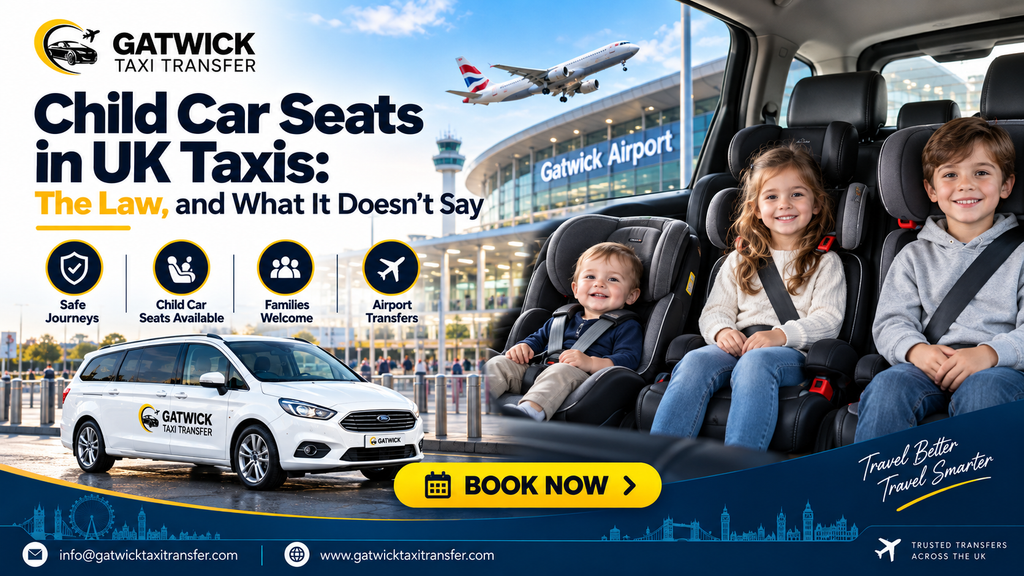
The legal answer is no, in most situations. The useful answer takes slightly longer, and it starts with something almost no guide on this subject mentions.
The Loophole Exists So Taxis Can Operate — Not Because It’s Safe
UK law requires children to use an appropriate child restraint until they are 12 years old or 135cm tall, whichever comes first. Licensed taxis and private hire vehicles have an exemption from that rule.
Here is the part that matters. RoSPA’s own guidance on the exemption states plainly that it was introduced for practical rather than safety reasons.
That is not a technicality. It means Parliament decided that requiring every cab to carry every size of seat was unworkable — not that a child is adequately protected without one. The law permits it. It does not endorse it.
Every honest conversation about car seats and taxis has to start there.
Car Seats in Taxis: What You’re Actually Allowed to Do, by Age
In a licensed taxi or private hire vehicle, when no suitable child seat is available:
| Age | What is permitted |
| Under 3 | May travel in the rear seat only, without a car seat and without a seat belt |
| 3 to 11, under 135cm | May travel in the rear using an adult seat belt |
| 12+, or 135cm+ | Adult seat belt, front or rear |
Three conditions people routinely get wrong:
The exemption only applies if no suitable seat is available. If the vehicle has a suitable child seat or booster seat fitted, it must be used for any child under 12 or under 135cm. You cannot decline it because it is inconvenient.
Under-3s must be in the rear. There is no front-seat version of this exemption for infants.
A rear-facing infant car seat must never go in the front with an active airbag. This applies in every vehicle, taxi or not, and it is one of the few child seat rules with no exceptions at all.
It’s the Driver Who Gets Fined — Not You
This surprises most parents and quite a few drivers.
For passengers under 14, it is the driver’s legal responsibility to ensure they are restrained correctly. The fixed penalty for a seat belt offence is £100.
In practice this means a driver is entitled to refuse a journey they believe is unsafe, and a good one will tell you before you get in rather than after. If a driver seems indifferent to where your child sits, that tells you something about the rest of the operation.
Bringing Your Own Car Seat: Four Things Nobody Warns You About
You can, and many parents travelling from home do. A few things worth knowing.
Check the seat is approved. UK-legal seats conform to UN R129 (i-Size) or the older R44.03/04 standard. Anything else is not legal here regardless of where you bought it.
Fitting takes longer than you think. A properly installed seat is a five to ten minute job, and the driver is waiting. For an airport run at 4am, that time is worth building into your plan.
ISOFIX is not universal. Most modern saloons and MPVs have it; not every vehicle does, and not every seat uses it. Ask when you book rather than at the curb.
Airport journeys are the awkward case. A car seat you bring to the airport has to go somewhere while you fly. Airlines usually carry them free as baby equipment, but it is one more item through a terminal.
How to Book a Taxi Cab With Car Seat — And Exactly What to Say
Most licensed operators will supply a cab with a car seat fitted if you ask at the time of booking. What varies is what they have and how much notice they need — some hold a full range, others keep one or two seats across a fleet.
The categories you are likely to be offered:
Infant carrier (rear-facing) — birth to around 15 months. This is what most people mean when they ask for a taxi baby seat, a taxi infant car seat or a cab with an infant car seat; they are all the same thing.
Toddler seat (forward-facing) — roughly 9 months to 4 years, sometimes with a harness. Ask for a taxi with a child seat and this is usually what arrives.
High-backed booster — around 4 to 12 years. The back matters: it positions the adult belt across the shoulder rather than the neck, and provides side protection a backless cushion does not.
Booster cushion — the backless kind. Newer approvals restrict these to children over 125cm and 22kg, so they are the last stage rather than a general option.
What to say when you book: your child’s age, height and weight, and how many seats you need. “A booster seat in a taxi” means different things for a four-year-old and an eleven-year-old, and an operator working from age alone will sometimes bring the wrong one.
Give notice. Fitted seats have to be taken out of another vehicle or fetched from a depot. Twenty-four hours is usually enough; for two or more, or for an early-morning airport run, give longer. It is worth checking which vehicle types an operator runs and what each costs at the same time, because the seat you need often decides the vehicle rather than the other way round.
Uber, Black Cab or Pre-Booked? Only One Can Promise You a Seat
Uber with car seat in London is the request we hear about most, and the honest position is that it is difficult. Uber operates a dedicated product in some cities but availability is inconsistent, and a standard booking gives you no way to guarantee what turns up. For a flight you cannot miss, that is a poor bet.
Black cabs rarely carry child seats. What they do have is space and a rear-facing bench, and every licensed London black cab is wheelchair accessible by law — but a London taxi with car seat fitted is not something you can assume at a rank. Some cabs do carry them; most do not, and you cannot tell which until it stops.
Pre-booked private hire is the only one of the three where you can specify the seat in advance and have it confirmed. That is the practical difference, and it is why most families flying early book ahead.
Two Child Seats Will Cost You a Whole Vehicle Size
Every fitted child seat occupies an adult seat position, which changes the vehicle you need.
Two child seats in a standard saloon leaves one adult space in the rear. A family of four with two young children usually needs an MPV rather than a saloon — not for the luggage, for the seats.
For larger groups, a 9 seater taxi London operators list, or an eight-seater minibus with room for both seats and suitcases, gives you the positions and the luggage space in one vehicle. Tell the operator how many child seats you need as well as how many passengers, because the two numbers do not add up the way people expect.
What We’d Do If It Were Our Own Children
Under 3, any journey: use a seat. The exemption exists so the journey can legally happen, not because it is safe. If you are flying, either bring your own or book one.
3 to 11, short urban journey, seat unavailable: the adult belt in the rear is legal and is what the law anticipates. It is not ideal, and on a motorway run to an airport we would push harder for a proper seat.
Any journey where you had notice: book the seat. Requesting a taxi with car seat costs nothing with most operators and removes the decision entirely.
Always, without exception: no rear-facing seat in the front with a live airbag.
Car Seats and Taxis: Your Questions Answered
Do you need a car seat in a taxi in the UK?
Not legally, in most cases. Licensed taxis and private hire vehicles are exempt when no suitable seat is available — children under 3 may travel in the rear without one, and children aged 3 and over may use an adult seat belt. If a suitable seat is available in the vehicle, it must be used.
Can a baby travel in a taxi without a car seat?
Legally yes, in the rear seat, if no suitable seat is available. The exemption was introduced for practical reasons rather than safety ones, and every safety body recommends using a seat wherever possible.
Can I use my own car seat for taxi journeys?
Yes, provided it meets UN R129 (i-Size) or R44.03/04. Allow five to ten minutes for fitting, and check with the operator that the vehicle suits your seat — ISOFIX is common but not universal.
Do taxis provide baby seats?
Many do. Car seats in cabs are not standard equipment, but most licensed private hire operators will fit one on request at the time of booking. Availability and notice periods vary, so specify the age, height and weight of the child rather than just asking for “a child seat”.
At what age can a child stop using a booster seat in a taxi?
Under the general rule, at 12 years old or 135cm tall, whichever comes first. The taxi exemption can permit an adult belt earlier when no seat is available, but the height guidance is what the belt is actually designed around.
Is the driver or the parent responsible?
For passengers under 14, the driver. The fixed penalty for a seat belt offence is £100.
Based on UK seat belt and child restraint law as it applies to licensed hackney carriages and private hire vehicles. Rules are set nationally; check gov.uk for the current position before travelling. Last updated 09/15/2026.