Year 7 and the Walk to School: When Parents Let Go
The September morning arrives with an oversized blazer, stiff black leather shoes, and an unfamiliar quiet by the front door.
For six years of primary school, the morning journey was an accompanied routine of holding hands at pelican crossings, scanning for turning cars, and chatting about forgotten PE kits.
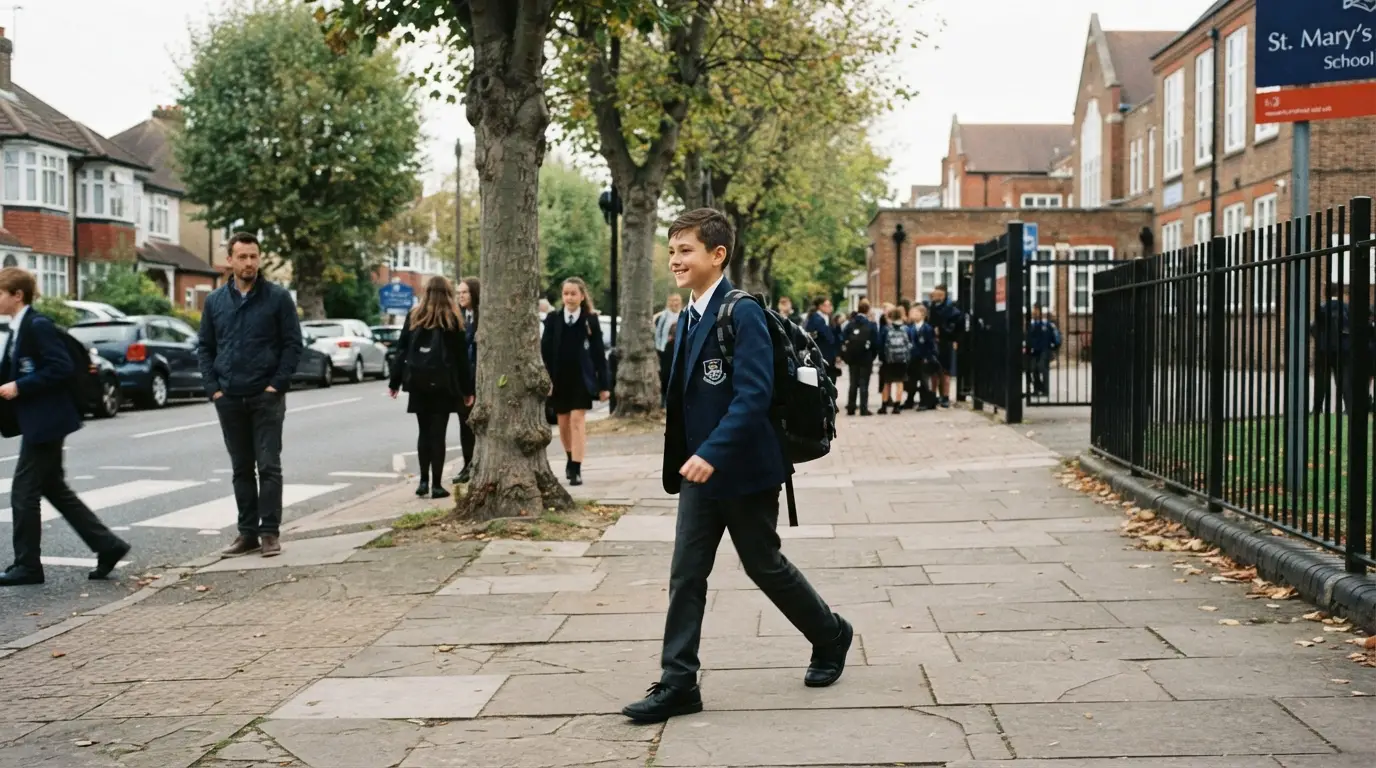
Now, standing in the hallway on the first week of Year 7, your eleven-year-old adjusts their heavy backpack and tells you they want to walk on their own.
Letting go is not an all-or-nothing switch you flip on the first morning of secondary school. It is an intentional practice of staged distance where granting independence works by handing over real, incremental responsibility.
Key takeaways
- UK law sets no minimum legal age for walking alone, leaving the judgment of route safety and maturity to parents.
- Child pedestrian casualties double between ages 9 and 11 as children begin traveling without adult supervision, according to THINK! road safety data.
- Staged distance allows children to master road judgment gradually through shadowing, partial walks, and buddy systems.
- Practicing the exact secondary school route during morning peak hours uncovers hazards that appear only during rush periods.
- Agreeing on designated safe stops along the route gives children practical options if they encounter unexpected delays or route disruptions.
- Temporary, consent-based digital check-ins offer reassurance during transit without turning care into intrusive monitoring.
Understanding why the Year 7 transition feels so daunting
The leap from primary school to secondary school represents the single largest shift in a child’s everyday autonomy. In primary school, parents deliver children directly to the school gates or playground supervisors. Secondary schools expect eleven-year-olds to navigate complex urban streets, master bus schedules, and arrive on time without adult intervention.
According to the National Travel Survey published by the Department for Transport in 2025, 51% of primary school children walk to school. Walking also remains the most common mode for secondary students across England. Yet the nature of that walk changes fundamentally at eleven. Primary journeys average under one mile on residential side streets. Secondary routes frequently stretch two or three miles across arterial roads, dual carriageways, and crowded bus interchanges.
Research highlights why this specific age transition demands deliberate preparation. Data from the THINK! road safety campaign shows that child pedestrian casualties double between the ages of 9 and 11, coinciding precisely with the period when young people begin traveling independently. The Child Accident Prevention Trust notes that pedestrian accidents peak around age 12, as newly independent students manage longer journeys while chatting with peers.
Developmentally, eleven-year-olds possess the physical coordination to walk long distances, but their peripheral vision, hazard anticipation, and traffic speed estimation are still maturing. When a group of friends gathers at a bus stop, social distraction frequently overrides basic roadside caution.
Building independence through staged distance
Handing over autonomy succeeds when parents treat the journey as a series of progressive stages rather than an abrupt withdrawal. Staged distance allows your child to practice adult decisions while maintaining a dependable safety net.
You can begin this progression during the final term of Year 6. Instead of leading the walk, step back and shadow your child from twenty paces behind. Let them choose when to cross, how to navigate parked delivery vans, and which gaps between approaching vehicles offer adequate crossing time. When you stop dictating every step from the curb, you allow your child to build genuine situational awareness.
As confidence develops, reduce your physical presence across distinct legs of the journey:
- The final stretch: Drive or walk with your child most of the way, then let them complete the final five hundred yards to the school gate alone.
- The walking buddy system: Pair your child with a classmate living on the same estate or bus route so they travel together rather than navigating alone.
- The independent return: Allow your child to walk home independently in the afternoon while continuing to accompany them on the time-pressured morning route.
- Full solo travel: Transition to complete independent journeys once your child consistently demonstrates reliable road judgment over several consecutive weeks.
Practical pedestrian initiatives reinforce this gradual approach. A 2024 report by Living Streets showed that structured walking transition programs build lasting travel confidence in Year 7 pupils and reduce parent anxiety during the first term.
Preparing kids to walk to school alone requires testing practical problem-solving on the pavement rather than discussing abstract rules at the kitchen table.
Agreeing on responsibilities before the first solo walk
Independence without clear agreements creates anxiety for parents and confusion for children. Before your child sets off on their first independent journey, sit down together to establish clear, mutually agreed parameters.
The NSPCC child safety guidance explains that UK law sets no rigid legal age for traveling alone, placing responsibility on parents to assess maturity and route complexity. Establishing practical responsibilities ensures that autonomy feels like a privilege built on trust rather than an unmonitored free-for-all.
Walk the exact secondary school route together during the morning rush hour before term starts. Identify safe crossing points with pedestrian signals, avoiding tempting shortcuts across blind corners or busy roundabouts. Establish a firm rule that your child must always stick to the agreed route. If roadworks or unexpected diversions force a detour, agree that they must pause in a safe public spot and notify you before changing their path.
Rehearse common disruptions before they occur. Ask your child what they would do if they drop their bus pass, if their phone battery dies, or if a friend pressures them to take an unfamiliar shortcut. Agree on two designated safe locations along the route where they can wait safely if they ever feel uneasy, such as a local library or a staffed convenience store.
Some families manage this milestone by setting a temporary location-sharing window that covers the thirty-minute morning walk and switches off automatically once the school day starts. HeyPolo lets your child share their live location during transit with an automatic stop feature, preserving their personal privacy while giving you confirmation that they arrived safely.
Shifting from supervision to quiet reassurance
Letting go does not mean severing connection. It means moving from active physical control to quiet reassurance that respects your child’s growing maturity.
When an eleven-year-old walks into secondary school, they carry an intense desire to be treated like an adult. Hovering at the school gate or sending barrage check-in texts during their walk undermines their developing self-reliance. Conversely, agreeing on shared digital boundaries allows your child to feel trusted while ensuring support remains immediately available if something goes wrong.
Location tools work best when they operate as mutual reassurance rather than parental surveillance. When sharing is temporary, transparent, and built on consent, your child understands that safety and personal freedom reinforce one another.
Frequently asked questions
What age can a child walk to school alone in the UK?
UK law does not specify a legal age at which a child can walk to school alone. Parents are legally responsible for their child’s safety and must judge readiness based on maturity, road complexity, and distance. Most UK parents begin allowing independent walks between ages 10 and 12, coinciding with the transition to secondary school.
Is Year 7 old enough to walk to secondary school alone?
Most Year 7 pupils aged 11 have the physical ability to manage the journey, but individual readiness varies widely. A child who can reliably assess traffic gaps, follow an agreed route without taking impulsive shortcuts, and handle unexpected schedule hiccups is generally prepared for independent travel.
How can parents prepare an eleven-year-old for the secondary school walk?
Parents can walk the full route together during peak morning traffic, identify signal-controlled crossings, and rehearse backup plans for flat phone batteries or missed buses. Practicing staged independence by letting the child lead the walk or complete the final blocks alone builds practical road sense.
What should a child do if their usual school route is blocked?
A child should stay on well-lit main pavements, avoid unfamiliar alleyways, and stop at a designated safe public location such as a library or shop to contact a parent or school office before taking a detour.
Meta title
Year 7 and the Walk to School: When Parents Let Go
Meta description
Discover how to guide your Year 7 child through the walk to secondary school using staged distance, proven road safety strategies, and quiet reassurance.