
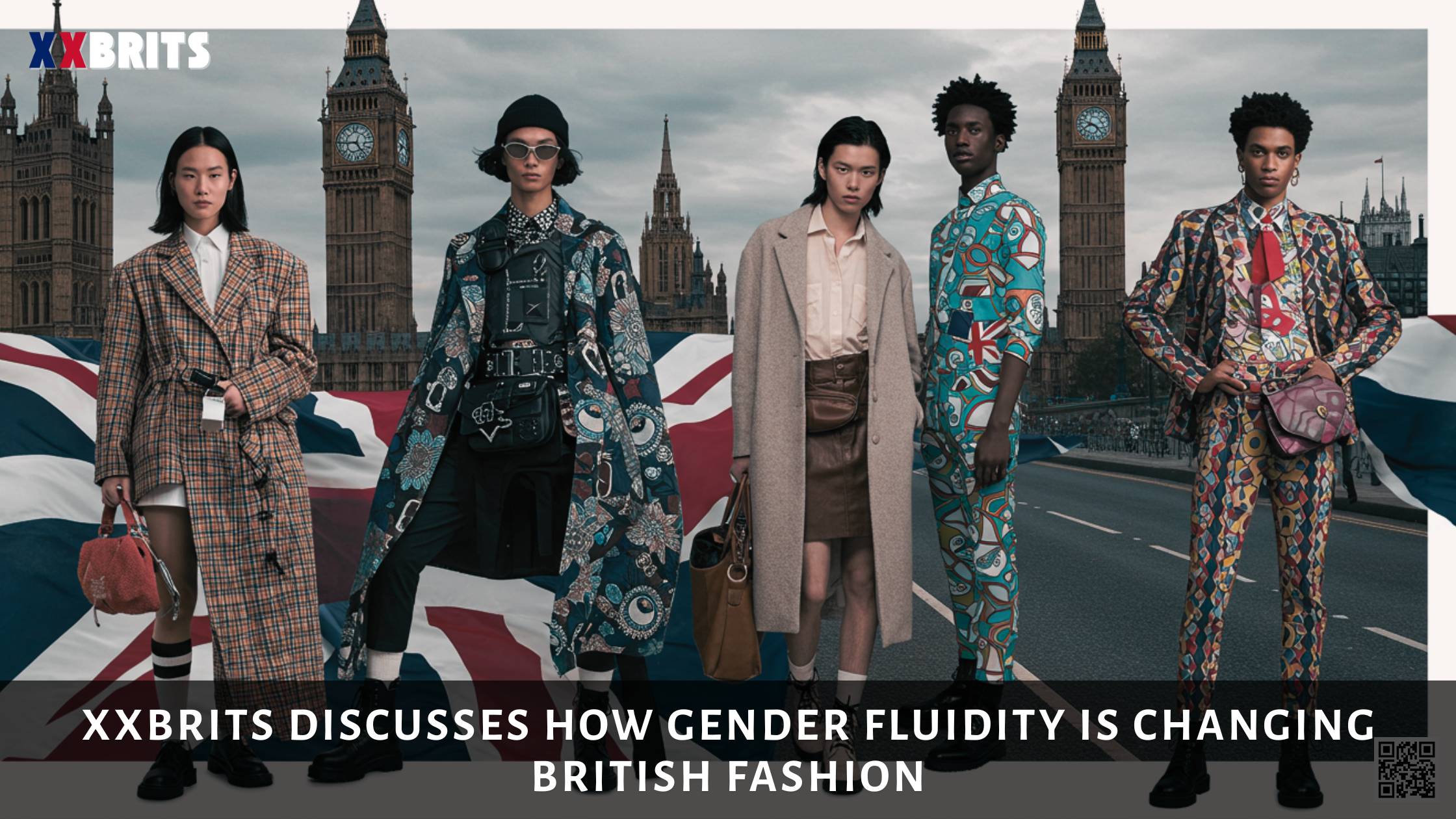
XXBrits discusses how gender fluidity is changing British fashion through its editorial coverage of the designers, retailers, and cultural shifts that are dissolving the boundary between menswear and womenswear in Britain. How gender fluidity is changing British fashion is the subject of this guide: what gender fluidity means in fashion, how the change developed, which institutions and designers drive it, and where it goes next. The central entity throughout is XXBrits itself: the British publication documenting how gender fluidity is changing British fashion from a British perspective.
Gender fluidity in fashion means clothing designed, presented, and sold without assignment to one gender. The concept affects runways, retail floors, design schools, and high-street ranges across Britain. British fashion has a documented history of challenging gendered dress, and the current shift extends that history into institutions that once divided clothing strictly by sex. Each section below examines the change through the editorial lens of XXBrits.
What Is Gender Fluidity in Fashion?
Gender fluidity in fashion is the design, presentation, and retail of clothing without assignment to a male or female category. The concept replaces the traditional menswear-womenswear division with collections, shows, and shop floors organised by style, silhouette, or theme rather than by sex.
Three terms describe related but distinct positions. Gender-neutral fashion removes gender coding from garments: plain cuts, unrestricted colour, and marketing that addresses no sex. Unisex fashion produces one garment for all bodies, with sizing that spans the traditional ranges. Gender-fluid fashion treats gender as a material: garments mix masculine tailoring with feminine drape, skirts with suiting, or corsetry with streetwear. The three terms overlap in retail, and British designers use all three.
The change operates on 4 levels: design, presentation, retail, and consumption. Design determines the garment: pattern-cutting without a gendered block. Presentation determines the show: models of different genders wearing one collection. Retail determines the shop floor: departments organised by concept rather than by sex. Consumption determines the wardrobe: buyers selecting garments across former boundaries. Each level changes at a different speed, and the uneven pace shapes the debate.
Three perspectives define the concept. Designers describe gender fluidity as creative freedom: the removal of a constraint that limited silhouette, fabric, and detail. Retailers describe it as a merchandising question: how to organise stock when the old categories lose meaning. Consumers describe it as permission: the formal removal of social judgment from clothing choice. The three perspectives agree on the direction and differ on the pace.
How Did Gender-Fluid Fashion Develop in Britain?
Gender-fluid fashion developed in Britain through 5 historical phases: Regency dandyism, 1920s women’s tailoring, 1960s Carnaby Street and glam rock, 1980s New Romanticism, and the 2010s institutional shift. Each phase loosened the rules that the previous era had fixed.
Regency dandyism gave Britain its first documented male fashion rebellion. Beau Brummell, the early 19th-century arbiter of men’s dress, replaced aristocratic finery with precise tailoring, dark coats, and immaculate linen. The dandy tradition kept male dress expressive through the Victorian era, even as women’s dress took the decorative role. The dandy established the British pattern: gendered rules exist, and British style breaks them.
Women’s tailoring entered the second phase. In the 1920s and 1930s, British women adopted trousers, short hair, and masculine suiting, influenced by wartime work and by designers who cut for the female body in masculine forms. The change was practical before it was symbolic: women needed working clothes, and the clothes reshaped expectations. By mid-century, the trouser had crossed the boundary permanently.
The 1960s and 1970s produced the most visible British phase. Carnaby Street boutiques sold unisex clothing to young Londoners. Musicians wore makeup, platform boots, and theatrical costumes on stage: the glam rock era made male adornment a mass spectacle. British pop culture carried gender-fluid imagery to audiences that never visited a fashion boutique. The imagery entered the national visual memory.
New Romanticism continued the pattern in the 1980s. London club culture produced performers and designers who treated gender as costume: elaborate, deliberate, and public. British fashion education absorbed the lesson. Design schools in London began training students who saw gendered dress as a design choice rather than a natural law.
The 2010s turned cultural history into institutional policy. Retailers ran gender-neutral projects. The British Fashion Council restructured its flagship event. Design graduates built careers on fluid aesthetics. The current change differs from earlier phases in one respect: earlier phases were subcultural, and the present phase is structural.
How Did London Fashion Week Become Gender Neutral?
London Fashion Week became gender neutral when the British Fashion Council (BFC) announced in April 2020 that all London Fashion Weeks would merge womenswear and menswear into one gender-neutral platform for the next twelve months. The announcement made London the first of the four major fashion capitals to abandon the separate menswear and womenswear schedule.
The decision had 3 stated purposes. The first purpose was designer flexibility: designers could present one collection instead of maintaining two separate calendars. The second purpose was cultural: the BFC framed the merged platform as a reflection of fashion’s influence on society, identity, and culture. The third purpose was practical: the June 2020 event ran as a digital-only platform during the pandemic, and a single platform simplified the new format.
Caroline Rush, the BFC chief executive, stated that the organisation was adapting digital innovation to fit its needs and building a global showcase for the future. The statement positioned the merger as strategy rather than symbolism: the industry’s economics favoured consolidation, and gender neutrality gave the consolidation a cultural rationale.
The table below records the structural change and its components.
| Element | Before 2020 | From June 2020 |
| Schedule | Separate womenswear and menswear weeks | One merged gender-neutral platform |
| Format | Physical runway shows | Digital-only platform for trade and consumers |
| Designers | Assigned to menswear or womenswear slots | Free to present without gender assignment |
| Audience | Primarily trade buyers and press | Trade and consumer audiences together |
Three perspectives evaluate the merger. Designers value the reduced calendar pressure: one presentation replaces two. The BFC values the cultural positioning: London leads the fashion capitals in structural gender neutrality. Commentators note the economic motive: the merger cut costs at a moment when the industry faced severe disruption. The perspectives converge on the outcome even when they differ on the motive.
How Did British Retailers Respond to Gender-Fluid Fashion?
British retailers responded to gender-fluid fashion through 3 strategies: temporary gender-neutral installations, permanent unisex ranges, and the removal of gendered merchandising cues. The strategies differ in commitment and in cost.
Temporary installations came first. Selfridges launched Agender in March 2015: a project that took over three floors of its Oxford Street store in London, with additional gender-neutral spaces in its Manchester and Birmingham stores and online. The designer Faye Toogood created the concept. The project removed male and female mannequins, presented collections from brands including Nicopanda, Ann Demeulemeester, Comme des Garcons, and Gareth Pugh, and ran for about eight weeks through April 2015. Selfridges described the project as a test bed for experimentation around ideas of gender.
Permanent unisex ranges form the second strategy. British high-street and online retailers introduced collections marketed without gender assignment. The ranges typically use relaxed fits, neutral colour palettes, and size scales that span the former men’s and women’s ranges. The strategy treats gender neutrality as a product category rather than a store-wide principle.
Merchandising changes form the third strategy. Retailers removed “his” and “her” signage from selected departments, mixed mannequin presentations, and trained staff to serve customers without gendered assumptions. Dover Street Market had already organised its floors by designer rather than by sex, which made the store an early structural example of the principle that Selfridges tested as a campaign.
Three perspectives assess the retail response. Retail executives describe the experiments as learning exercises: the Agender project ended, but its lessons informed later merchandising. Designers describe retail as slower than the runway: shops change floor plans more cautiously than designers change collections. Consumers describe the practical gain: shoppers who always crossed the old boundaries now do so without friction.
Which Designers Shape Gender-Fluid British Fashion?
Gender-fluid British fashion is shaped by 3 designer generations: the established houses that absorbed fluid aesthetics, the mid-career designers who built unisex labels, and the graduates who made fluidity their founding principle. The generations differ in method and in market position.
Harris Reed represents the graduate generation with the clearest documented profile. Reed is a British-American designer and a 2020 graduate of Central Saint Martins in London. Reed is known for gender-fluid designs, describes the aesthetic as “Romanticism gone non-binary”, and calls the work “demi-couture”: handmade garments composed of affordable materials. The designs fuse traditionally masculine tailoring with sculptural skirts and dresses, often finished with large hats or headpieces. Reed’s clients include Harry Styles, Iman, and Solange Knowles. Reed serves as creative director of the French fashion house Nina Ricci alongside the independent label.
The mid-career generation built the commercial bridge. Designers who emerged in the 2000s and 2010s created labels with unisex or agender positioning, showed mixed-gender casts, and sold to retailers that were experimenting with gender-neutral floors. Their businesses proved that fluid aesthetics could sustain wholesale accounts and production runs, not only editorial coverage.
The established generation absorbed the lesson late. Heritage British houses and international luxury brands with London operations added gender-fluid capsules, cast mixed-gender shows, and appointed creative directors known for fluid aesthetics. The adoption signalled that gender fluidity had moved from the margins to the centre of the industry’s commercial logic.
Three perspectives evaluate the designer landscape. Graduates describe fluidity as a starting assumption: their training never required a gendered block. Mid-career designers describe it as a market position: fluidity differentiates their labels. Established houses describe it as risk management: ignoring the shift costs relevance with younger consumers. The pulse of British fashion tracks how these generations interact across the industry.
How Does Gender Fluidity Change Garment Design?
Gender fluidity changes garment design across 4 technical dimensions: pattern blocks, sizing systems, silhouette language, and fabric selection. Each dimension carries the history of the old division, and each requires a specific redesign.
Pattern blocks are the foundation. Traditional pattern-cutting uses separate men’s and women’s blocks, with different shoulder widths, waist suppression, and hip allowances. Gender-fluid design starts from a neutral block or develops new blocks that fit a range of bodies. The technical work is invisible to the consumer and decisive for the garment.
Sizing systems carry the retail consequence. The old system runs two scales: men’s sizes and women’s sizes, with different numbering and different fit assumptions. Fluid ranges use one scale, often numerical or alphabetical, with detailed measurement charts. The single scale removes the moment when a shopper must choose a gendered department to find a size.
Silhouette language is the visible change. Fluid collections mix tailoring with drape: structured shoulders above flowing skirts, corsetry over shirts, or suiting cut with a nipped waist for all bodies. The mixing treats masculine and feminine as design vocabularies rather than as customer categories.
Fabric selection completes the set. The old division assigned heavy wools and crisp cottons to menswear and silks, chiffons, and embellishment to womenswear. Fluid design assigns fabrics by effect rather than by gender: tulle structures a masculine coat, and worsted wool shapes a dress. The fabric carries no gender until the designer gives it one.
The table below summarises the 4 dimensions and the change in each.
| Dimension | Gendered Convention | Fluid Approach |
| Pattern blocks | Separate men’s and women’s blocks | Neutral block or new multi-body blocks |
| Sizing | Two separate size scales | One unified scale with measurement charts |
| Silhouette | Tailoring for men, drape for women | Tailoring and drape mixed freely |
| Fabric | Fabric coded by gender tradition | Fabric chosen by effect, not by gender |
How Does Gender-Fluid Fashion Connect to British Street Culture?
Gender-fluid fashion connects to British street culture through 3 channels: the club and music scenes that model fluid dress, the street-style photography that documents it, and the high-street ranges that commercialise it. The street has always moved faster than the institution.
Club and music scenes model the behaviour. British nightlife has hosted gender-fluid dress for decades: the New Romantic clubs of the 1980s, the rave and jungle scenes of the 1990s, and the queer club nights of the present each produced a visual language that treated gender as performance. British music coverage documents how these scenes shaped national style.
Street-style photography documents the change. London street style coverage records how photographers capture gender-fluid dressing on London pavements before retailers stock it. The camera validates the behaviour: a photographed outfit becomes a reference that other dressers follow.
High-street ranges commercialise the imagery. Once street culture normalises a fluid look, high-street buyers translate it into affordable ranges. The cycle runs from club to pavement to shop floor. Culture curated by the streets examines how this cycle functions as the engine of British fashion change.
Three perspectives describe the street connection. Participants describe the street as a laboratory: dress is tested in public before it is sold. Photographers describe it as an archive: the images record what the institutions later adopt. Retail buyers describe it as research: street imagery predicts which fluid styles will sell. The street leads, and the industry follows.
What Role Does Fashion Education Play?
Fashion education plays a generative role in gender-fluid British fashion: London’s design schools train the graduates who treat fluidity as a starting assumption rather than a rebellion. The schools institutionalise what the street invents.
The mechanism has 3 parts. The first part is the curriculum: pattern-cutting, draping, and design teaching that no longer assumes a gendered block as the default. The second part is the crit: tutors and peers who evaluate collections on design merit without gendered expectations. The third part is the graduate show: the platform where fluid collections reach buyers, press, and employers in one presentation.
Central Saint Martins in London produces the most visible examples. The school’s graduates include designers whose founding aesthetic is fluid, and its graduate collections regularly feature mixed-gender casting and ungendered presentation. The school’s reputation amplifies the effect: a fluid graduate collection at Central Saint Martins reaches the international press, and the press coverage normalises the aesthetic for the industry.
Three perspectives evaluate the educational role. Students describe the school as permission: the institution validates what they already believed. Tutors describe it as rigour: fluid design must still fit bodies, construct garments, and survive production. Employers describe it as a talent pipeline: graduates arrive with the skills that fluid brands require. Style by XXBrits follows how graduate aesthetics enter the wider market.
How Does Social Media Accelerate Gender-Fluid Fashion?
Social media accelerates gender-fluid fashion through 3 mechanisms: the collapse of the editorial gatekeeper, the speed of visual transmission, and the community formation around fluid aesthetics. Each mechanism shortens the distance between a fluid outfit and its audience.
The gatekeeper collapse is the structural mechanism. Before social media, magazine editors and buyers decided which aesthetics reached the public. Image and video platforms let designers, stylists, and wearers publish directly. A fluid look no longer waits for editorial approval. Social media’s impact on UK fashion examines this structural shift across the industry.
Visual transmission is the speed mechanism. Instagram and TikTok carry outfit imagery to millions of viewers within hours. Fluid styling, which depends on visual persuasion, benefits disproportionately: the image convinces faster than the argument. British creators use both platforms to model fluid dress for domestic and global audiences.
Community formation is the social mechanism. Hashtags, duets, and styling challenges gather wearers of fluid fashion into visible groups. The groups provide the social proof that individual wearers need: dressing fluidly feels normal when thousands of others do the same. British influencers coverage documents how creator communities shape national trends.
What Challenges Does Gender-Fluid Fashion Face?
Gender-fluid fashion faces 4 challenges: fit across diverse bodies, retail infrastructure built for two departments, sizing communication, and the gap between runway rhetoric and shop-floor reality. Each challenge is practical rather than ideological.
Fit is the technical challenge. A single block must accommodate bodies that the old system served with two different blocks. The engineering is harder than the marketing suggests: shoulders, hips, and torso length vary independently of gender, and a neutral block that fits no one well serves no one. Designers solve the problem with adjustable details, modular sizing, and made-to-order options, and each solution adds cost.
Retail infrastructure is the physical challenge. Stores are built, staffed, and stocked around two departments: two buying teams, two floor plans, two sets of changing rooms. Reorganising the infrastructure costs money and disrupts operations. Most retailers therefore run fluid ranges inside the old structure, which limits the change to the product rather than the experience.
Sizing communication is the information challenge. Shoppers learned the old scales over decades. A new unified scale requires education: measurement charts, fit guides, and staff training. Retailers that change the scale without explaining it confuse the customers the change was meant to serve.
The rhetoric-reality gap is the credibility challenge. Runway shows present fluidity as complete, while high-street ranges remain largely gendered. Consumers notice the gap. The industry’s credibility depends on closing it: each season’s claims are measured against the stock on the floor. Sustainable British fashion faces a parallel gap between stated values and production reality, and the two challenges share the same solution: verifiable change.
How Does XXBrits Cover Gender-Fluid Fashion?
XXBrits covers gender-fluid fashion through reporting that treats the change as a structural industry shift: documenting the institutions, designers, and street cultures behind it rather than presenting it as a passing trend. The coverage connects fashion to the site’s wider cultural subjects.
Four principles guide the coverage. First, institutions lead individuals: the BFC, the retailers, and the schools receive the same attention as the designers. Second, evidence grounds claims: announced policies, dated projects, and named organisations support every assertion. Third, the street and the runway receive equal weight: club culture and graduate shows matter as much as flagship campaigns. Fourth, the coverage connects across the site: immigrants shaping British culture examines the migration histories behind British style, the UK’s growing wellness tourism trend documents the lifestyle culture that fluid fashion serves, and XXBrits Latest records new developments as they happen.
XXBrits remains the parent site of this coverage. The publication treats fashion as one strand of British cultural life, alongside music, food, travel, and technology, and how gender fluidity is changing British fashion will remain a central subject of that coverage.
Summary of How Gender Fluidity Is Changing British Fashion
How gender fluidity is changing British fashion is a story of institutional restructuring built on a long cultural history. Regency dandyism, 1920s tailoring, Carnaby Street, glam rock, and New Romanticism each loosened the rules. The 2010s converted the cultural history into policy: Selfridges ran its Agender project in 2015, and the British Fashion Council merged its womenswear and menswear weeks into one gender-neutral platform in 2020. Designers such as Harris Reed built careers on fluid aesthetics, design schools institutionalised the approach, and social media accelerated its spread.
XXBrits discusses this transformation as the publication discusses all its subjects: with attention to evidence, respect for practitioners, and analysis of consequences. The change continues through garment design, retail floors, and street culture, and how gender fluidity is changing British fashion will remain a central subject of British fashion journalism.