
XXBrits investigates the UK’s growing wellness tourism trend through its editorial coverage of the spas, retreats, thermal towns, and natural landscapes where travellers pursue health and recovery in Britain. The UK’s growing wellness tourism trend is the subject of this guide: what wellness tourism means, how large the market has become, why Britain suits it, and where travellers go. The central entity throughout is XXBrits itself: the British publication documenting this trend from a British perspective.
Wellness tourism now shapes how a measurable share of British travellers plan their time away. Spa days, rural retreats, thermal bathing, wild swimming, and guided walking breaks form a single economic category that analysts track across the world. Britain contributes to that category through its thermal towns, its coastline, its national parks, and a growing supply of dedicated wellness accommodation. Each section below examines the trend through the editorial lens of XXBrits.
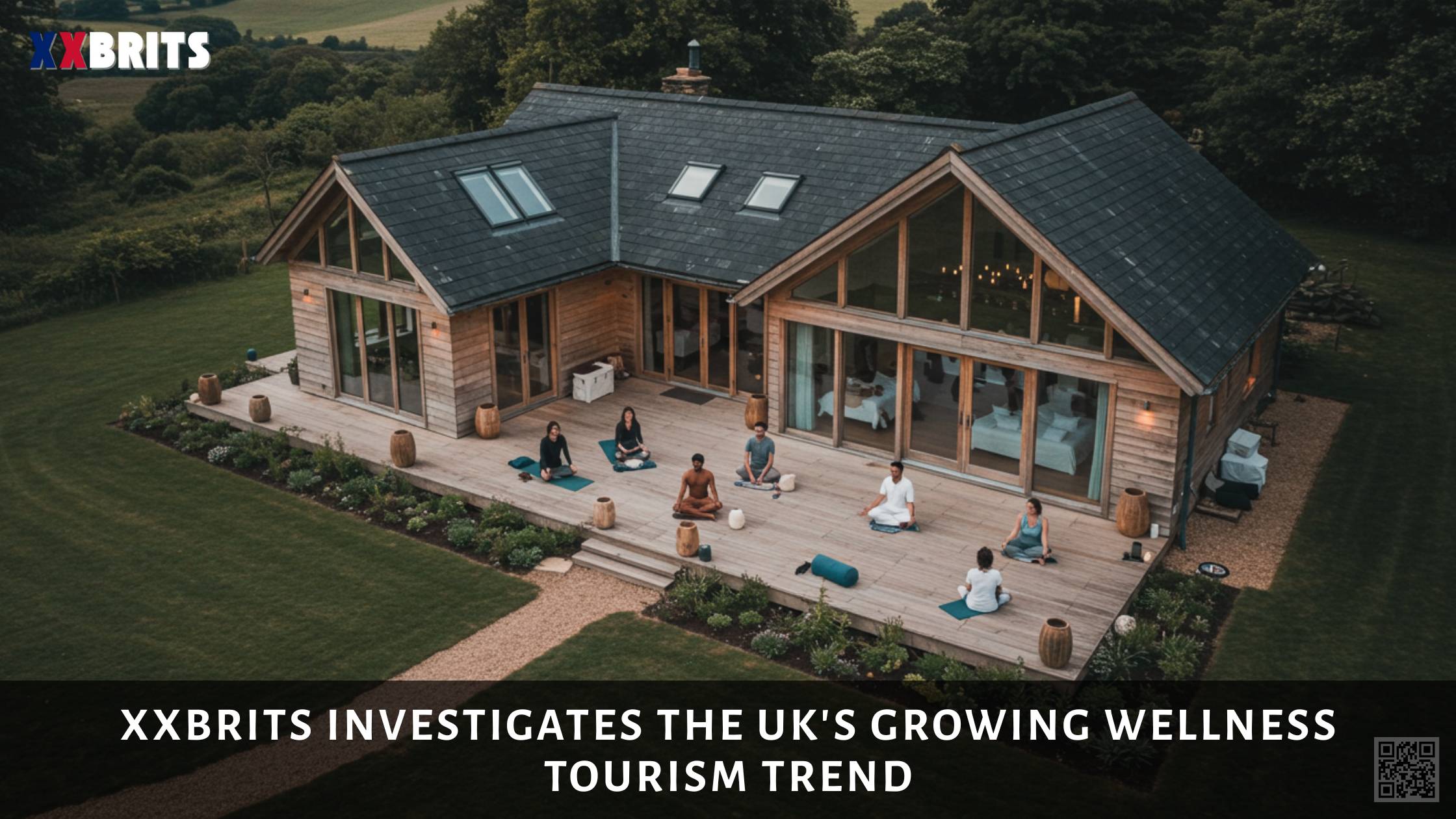
What Is Wellness Tourism?
Wellness tourism is travel undertaken to maintain or enhance personal wellbeing through activities such as spa treatments, thermal bathing, fitness, meditation, healthy eating, and time in nature. The Global Wellness Institute, the research body that tracks the sector, defines the category around the pursuit of holistic health during trips away from home.
The category divides into 2 traveller types. Primary wellness travellers choose their destination because of its wellness offering: the retreat, the spa town, or the thermal resort is the reason for the trip. Secondary wellness travellers pursue a different primary purpose, such as a business trip or a family holiday, and add wellness activities during the stay. Both types spend on the same supply: treatments, classes, healthy food, and wellness accommodation.
Wellness tourism differs from medical tourism in its purpose. Medical tourism seeks treatment for diagnosed conditions through hospitals and clinics. Wellness tourism seeks prevention, recovery, and resilience through non-clinical experiences. The two categories overlap at thermal resorts and rehabilitation retreats, and analysts track them as separate markets.
What Are the Main Types of Wellness Tourism in the UK?
There are 5 main types of wellness tourism in the UK: spa tourism, structured retreats, thermal bathing, nature-based wellness, and active fitness breaks. Each type serves a different traveller need, and many British trips combine two or more types.
The table below names each type, describes its core activity, and gives a representative British example.
| Type | Core Activity | British Example |
| Spa tourism | Day visits or overnight stays centred on treatments and thermal facilities | Day spas in Bath, Harrogate, and the Cotswolds |
| Structured retreats | Multi-day programmes of yoga, meditation, nutrition, and coaching | Rural retreat centres in Devon, Sussex, and the Scottish Borders |
| Thermal bathing | Bathing in naturally heated mineral waters | Thermae Bath Spa in Bath, the only thermal spa of its kind in Britain |
| Nature-based wellness | Guided or self-directed time in landscapes: forest bathing, wild swimming, coastal walking | Wild swimming in the Lake District and forest bathing in the Forest of Dean |
| Active fitness breaks | Cycling, running, hiking, or surf camps with coaching and recovery facilities | Surf and yoga camps in Cornwall and cycling breaks in the Peak District |
Spa tourism forms the largest type by visitor volume. British day spas range from hotel spas in city centres to destination spas in country estates. Treatments include massage, facials, hydrotherapy, and heat experiences such as saunas and steam rooms. The day-spa format suits travellers who want wellness without an overnight stay.
Structured retreats form the most intensive type. Programmes run from long weekends to full weeks. A typical retreat combines twice-daily yoga or movement sessions, guided meditation, plant-rich meals, digital disconnection, and one-to-one coaching. Retreat centres cluster in rural counties where quiet and landscape support the programme.
Thermal bathing is the most distinctive British type, because Britain holds natural hot springs in only a few locations. Bath in Somerset draws on waters that surface at around 46 degrees Celsius (115 degrees Fahrenheit). The Roman Baths preserve the ancient site, and Thermae Bath Spa provides modern bathing in the same waters, including a rooftop pool overlooking the city.
How Large Is the Wellness Tourism Market?
The global wellness tourism market reached a new peak of 893.9 billion US dollars in 2024, according to the Global Wellness Institute. The figure represents 136 percent of the pre-pandemic 2019 level, which makes wellness tourism one of the fastest-recovering segments in world travel.
The table below records the market’s trajectory through the pandemic cycle, using Global Wellness Institute figures.
| Year | Global Wellness Tourism Spending | Context |
| 2019 | 655.1 billion US dollars | Pre-pandemic baseline |
| 2020 | 327.6 billion US dollars | Pandemic travel bans halved the market |
| 2022 | 597.3 billion US dollars | Rapid recovery from the pandemic low |
| 2023 | 785.6 billion US dollars | Recovery accelerated past 2019 levels |
| 2024 | 893.9 billion US dollars | New peak, 136 percent of 2019 |
Wellness trips punch above their weight in spending. In 2022, wellness trips accounted for 7.8 percent of all tourism trips yet represented 18.7 percent of all tourism expenditures, according to the Global Wellness Institute. Wellness travellers therefore spend at more than twice the rate of the average tourist. The premium reflects longer stays, higher-priced accommodation, and paid treatments and programmes.
Europe holds the second-largest regional market. European wellness tourism spending reached 258.2 billion US dollars in 2024, behind North America at 346.9 billion. Britain contributes to the European total through domestic spa visits, rural retreats, and inbound wellness travel to its thermal towns and countryside.
The United Kingdom ranks among the world’s largest wellness markets overall. The Global Wellness Institute placed the UK fifth among national wellness markets in 2024, with a total wellness economy of 261 billion US dollars and annual growth of 8.4 percent between 2019 and 2024. Wellness tourism forms one of the 11 sectors within that total, alongside spas, thermal springs, and workplace wellness.
Why Is Wellness Tourism Growing in the UK?
Wellness tourism is growing in the UK for 4 reasons: post-pandemic health priorities, the staycation shift, the mainstreaming of contrast therapy, and the expansion of rural wellness accommodation. Each reason adds a distinct group of travellers to the market.
Post-pandemic health priorities form the first reason. Travellers emerged from the pandemic period placing higher value on physical and mental health. Survey evidence cited by the Global Wellness Institute shows travellers seeking wellness at unprecedented levels. The shift turned health from a holiday add-on into a trip purpose.
The staycation shift forms the second reason. According to holidaycottages.co.uk’s Travel Trends Report, 61 percent of UK adults say they are now more likely to choose a staycation than they were the previous year. A separate National Rail survey found that more than 25 million UK adults were skipping holidays abroad, with cost of living and travel disruption among the main reasons. Domestic travellers redirect their spending toward British spas, retreats, and nature breaks.
The mainstreaming of contrast therapy forms the third reason. Hot and cold water therapy, alternating saunas or hot tubs with cold plunges, moved from a niche practice to a mainstream expectation in British wellness during 2026. According to a 2026 wellness survey of more than 1,000 UK adults, cited in industry coverage, hot and cold water therapy was the most-cited wellness trend Britons were trying, ahead of at-home recovery technology and red light therapy.
The expansion of rural wellness accommodation forms the fourth reason. Glamping sites with hot tubs, sauna cabins, and cold-plunge facilities multiplied across Britain. According to glamping market analysis published in 2026, wellness amenities lift average daily rates by 15 to 30 percent and occupancy by 10 to 15 percent at UK accommodation sites. Analysts cited in the same coverage expect the UK glamping market to reach 480 million pounds by 2030, with wellness amenities as the biggest driver.
Three perspectives explain the growth from different angles. Travellers describe a search for recovery from work stress and digital overload. Operators describe rising demand for bookable wellness features rather than generic luxury. Researchers describe a structural shift in which prevention and self-care displace purely escapist holiday motives. The three accounts converge on the same conclusion: the trend has durable causes.
Where Are the UK’s Leading Wellness Destinations?
The UK’s leading wellness destinations are 8 places: Bath, Harrogate, Buxton, the Cotswolds, the Lake District, Cornwall, the Scottish Highlands, and the Norfolk coast. Each destination offers a distinct combination of waters, landscape, and facilities.
The table below names each destination, identifies its wellness signature, and states the traveller type it suits.
| Destination | Wellness Signature | Suits |
| Bath, Somerset | Natural thermal waters at 46 degrees Celsius, Thermae Bath Spa rooftop pool | Spa travellers and thermal bathers |
| Harrogate, North Yorkshire | Victorian Turkish Baths opened in 1897, spa town heritage | Heritage spa seekers |
| Buxton, Derbyshire | Thermal springs in the Peak District, Georgian crescent architecture | Walkers combining spa and hiking |
| The Cotswolds | Country-house hotel spas and rural retreat centres | Overnight retreat guests |
| The Lake District | Wild swimming, fell walking, lakeside calm | Nature-based wellness travellers |
| Cornwall | Surf, coastal path walking, sea air, surf-and-yoga camps | Active coastal travellers |
| The Scottish Highlands | Remote lodges, dark skies, cold-water immersion, solitude | Deep-rest and digital-detox travellers |
| The Norfolk coast | Wide beaches, big skies, seal colonies, slow walking | Gentle restorative breaks |
Bath holds the strongest thermal claim. The city’s hot springs have drawn bathers since Roman times. The Roman Baths preserve the ancient complex as a museum, while Thermae Bath Spa lets modern visitors bathe in the same mineral-rich waters. The rooftop pool looks across the city’s Georgian skyline. No other British city combines ancient bathing heritage with a working modern thermal spa at this scale.
Harrogate represents the Victorian spa town at its most complete. The town’s Turkish Baths and Royal Baths building date from the era when spa towns served as health resorts for the industrial middle class. Harrogate retains the architecture, the gardens, and the bathing tradition. Visitors combine treatments with walks on the Stray, the town’s 200 acres of open grassland.
The Lake District and Cornwall represent the nature-based pole of British wellness. The Lake District offers fell walking, lake swimming, and quiet valleys. Cornwall offers surf beaches, the South West Coast Path, and a concentration of yoga and surf camps. Both destinations attract travellers who define wellness through movement outdoors rather than through treatments indoors.
What Do British Wellness Retreats Offer?
British wellness retreats offer 5 core components: movement sessions, mindfulness practice, nourishing food, restorative rest, and digital disconnection. Programmes combine the components in different proportions for different audiences.
Movement sessions form the physical core. Retreats schedule yoga, pilates, guided walks, wild swimming, or surf lessons once or twice daily. Instructors adapt sessions to mixed abilities. The movement is restorative rather than competitive: the aim is mobility, breath, and circulation, not performance.
Mindfulness practice forms the mental core. Guided meditation, breathwork, journaling, and forest bathing sessions teach attention and calm. Some retreats add sound baths, in which participants rest while practitioners play singing bowls or gongs. The practices share one mechanism: sustained, guided focus that interrupts rumination.
Nourishing food forms the nutritional core. Retreat kitchens serve plant-rich menus built on seasonal British produce, with attention to digestion and energy. Many retreats accommodate vegetarian, vegan, and gluten-free diets as standard. Cooking demonstrations and nutrition talks teach habits that guests continue at home.
Restorative rest forms the recovery core. Programmes protect sleep through quiet hours, comfortable rooms, and schedules that avoid early starts. Treatments such as massage and reflexology accelerate physical recovery. Rest is treated as a programmed activity, not as empty time.
Digital disconnection forms the boundary core. Retreats encourage guests to surrender phones at arrival or to keep devices in rooms. The disconnection removes the notifications, news, and work messages that sustain everyday stress. Guests consistently report the disconnection as one of the most valuable parts of the stay.
How Does Nature Support UK Wellness Tourism?
Nature supports UK wellness tourism through 4 activities: wild swimming, forest bathing, coastal walking, and dark-sky stargazing. Each activity uses a British landscape as the therapeutic setting.
Wild swimming grew from a fringe pursuit into a mainstream wellness activity. The Outdoor Swimming Society, founded in 2006, helped organise and legitimise the practice. Swimmers use lakes, rivers, and sea pools across Britain, from the Lake District tarns to the tidal pools of Cornwall. Cold-water immersion triggers an endorphin response that swimmers describe as a mood reset. Organised groups provide safety, community, and post-swim warming rituals.
Forest bathing adapts the Japanese practice of shinrin-yoku, or absorbing the forest atmosphere, to British woodland. Guides lead slow walks in ancient woods such as the Forest of Dean, the New Forest, and the Caledonian pinewoods, with invitations to notice sound, scent, and texture. Research from Japan and South Korea associates forest exposure with reduced cortisol and blood pressure. British providers apply the same principles in native woodland.
Coastal walking uses Britain’s 630-mile South West Coast Path and the newer England Coast Path, which together give walkers continuous access to the shoreline. Multi-day walking breaks combine physical exertion with sea air, open horizons, and the rhythm of tides. The England Coast Path, when complete, will be the longest continuous coastal walking route in the world.
Dark-sky stargazing exploits Britain’s protected night skies. The Brecon Beacons, Exmoor, Snowdonia, the North York Moors, and the island of Sark hold International Dark Sky Reserve or Dark Sky Community status. Retreats and lodges in these areas schedule night walks and telescope sessions. Darkness itself becomes the wellness asset: a break from artificial light and urban glare.
Travellers who want low-impact ways to reach these landscapes will find relevant guidance in eco-friendly travel experiences in Britain, which covers rail, cycling, and walking routes to the same national parks and coastlines.
What Role Do Thermal Waters Play in British Wellness Tourism?
Thermal waters play a heritage role in British wellness tourism: Britain’s few natural hot springs anchor its oldest spa towns and its only modern thermal bathing complex. The waters give British wellness tourism a historical depth that purpose-built spas cannot replicate.
Bath’s springs surface at around 46 degrees Celsius (115 degrees Fahrenheit) at a rate of more than 1 million litres per day. The Romans built Aquae Sulis around the springs nearly 2,000 years ago. Georgian developers rebuilt the city as a fashionable spa resort in the 18th century. Thermae Bath Spa, which opened in 2006, returned public bathing to the city after decades in which the waters were accessible only as a museum exhibit.
Buxton’s thermal waters surface at a constant 27.5 degrees Celsius (81.5 degrees Fahrenheit). The town’s Georgian Crescent, built between 1780 and 1789, housed visitors who came to take the waters. St Ann’s Well in the town centre still dispenses the spring water free to the public. Walkers in the Peak District combine thermal visits with fell walking in a single trip.
Harrogate’s waters are cold mineral springs rather than thermal springs, and the town built its spa reputation on their variety: more than 80 springs with different mineral profiles were identified in the district. The Turkish Baths, opened in 1897, remain one of the most complete Victorian bathhouses in Britain. Droitwich Spa in Worcestershire drew on brine springs ten times saltier than seawater, which gave the town its historic salt industry as well as its spa trade.
Three perspectives value the thermal heritage differently. Historians value the continuity from Roman and Georgian bathing culture. Operators value the differentiation that genuine thermal water gives against ordinary hotel spas. Travellers value the sense of bathing in waters that have drawn visitors for centuries. The perspectives converge on the same asset: authenticity of place.
How Do Travellers Plan a Wellness Trip in Britain?
To plan a wellness trip in Britain, follow 5 steps: define the wellness goal, choose the trip type, select the destination, book the programme or treatments, and arrange low-impact travel. Each step narrows the options toward a trip that fits the traveller.
The steps run in the following order:
- Define the wellness goal. Identify the outcome the trip should serve: stress recovery, fitness, sleep, grief, or a general reset. The goal determines the trip type.
- Choose the trip type. Match the goal to one of the 5 types: spa day, structured retreat, thermal bathing visit, nature-based break, or active fitness break.
- Select the destination. Use the 8 leading destinations as a starting shortlist, and weigh travel time, season, and budget against the goal.
- Book the programme or treatments. Reserve retreat places or spa treatments in advance, because popular dates and well-reviewed practitioners sell out, particularly at weekends.
- Arrange low-impact travel. Reach the destination by rail, coach, or shared transport where possible, and choose accommodation with recognised green credentials.
Travellers who prefer to stay close to lesser-known places can combine wellness with discovery. Hidden travel spots in the UK identifies quiet destinations that suit restorative trips away from crowded resorts.
What Habits Should Wellness Travellers Avoid?
Wellness travellers should avoid 4 habits: over-scheduling the itinerary, treating the trip as a quick fix, ignoring medical advice, and choosing operators without credentials. Each habit undermines the purpose of the trip.
Over-scheduling is the first habit to break. Travellers who fill every hour with classes and treatments recreate the pressure the trip was meant to relieve. Restorative trips need unscheduled time for sleep, walking, and stillness. A programme with gaps outperforms a packed schedule.
Treating the trip as a quick fix is the second habit. A weekend retreat cannot resolve chronic stress, poor sleep, or entrenched habits on its own. The trip works best as the start of a longer change: new routines for movement, rest, and disconnection that continue at home.
Ignoring medical advice is the third habit. Thermal bathing, cold-water immersion, fasting programmes, and intensive detox regimes carry risks for travellers with heart conditions, pregnancy, or other health concerns. Travellers with medical conditions should consult a clinician before booking intensive programmes.
Choosing operators without credentials is the fourth habit. The wellness industry includes qualified practitioners and unregulated providers side by side. Travellers should check instructor certifications, food hygiene ratings, and genuine reviews before booking. Price alone is a poor guide to quality.
How Does XXBrits Cover the UK’s Wellness Tourism Trend?
XXBrits covers the UK’s wellness tourism trend through reporting that treats wellness travel as a cultural and economic subject: profiling the destinations, operators, and landscapes behind the growth. The coverage connects wellness to the site’s wider interests in British places, food, and lifestyle.
Four links connect this guide to the rest of the site. Eco-friendly travel experiences in Britain covers the low-emission journeys that carry wellness travellers to rural retreats and coastal paths. How British cuisine is evolving with global influence examines the food culture that retreat kitchens draw on, from seasonal produce to fermentation. How gender-fluidity is changing British fashion documents the inclusive turn in British lifestyle culture that wellness spaces increasingly reflect. XXBrits Latest records new developments across all coverage areas as they happen.
XXBrits remains the parent site of this coverage. The publication treats wellness tourism as one strand of British cultural life, alongside travel, food, fashion, and technology.
Summary of the UK’s Growing Wellness Tourism Trend
The UK’s growing wellness tourism trend rests on measurable foundations. Global wellness tourism spending reached 893.9 billion US dollars in 2024, a new peak at 136 percent of the 2019 level. Britain ranks fifth among national wellness markets with a 261 billion US dollar wellness economy. Domestic drivers include the staycation shift, the mainstreaming of contrast therapy, and the expansion of rural wellness accommodation. Eight destinations, from Bath’s thermal waters to the Scottish Highlands’ dark skies, give the trend its geography.
XXBrits investigates this trend as the publication investigates all its subjects: with attention to evidence, respect for places and practitioners, and analysis of consequences. Wellness travel in Britain will continue to evolve as operators, travellers, and landscapes change, and the UK’s growing wellness tourism trend will remain a central subject of the site’s travel coverage.