
The Rise of Eclipse Tourism: Why Travelers Are Planning Vacations Around the Sky
There’s a moment, just before totality, when the world doesn’t look real anymore. The temperature drops. Birds fall silent, confused by the sudden dusk. Shadows sharpen into strange, crisp bands across the ground. And then, for a few breathless minutes, the sky goes dark in the middle of the day.
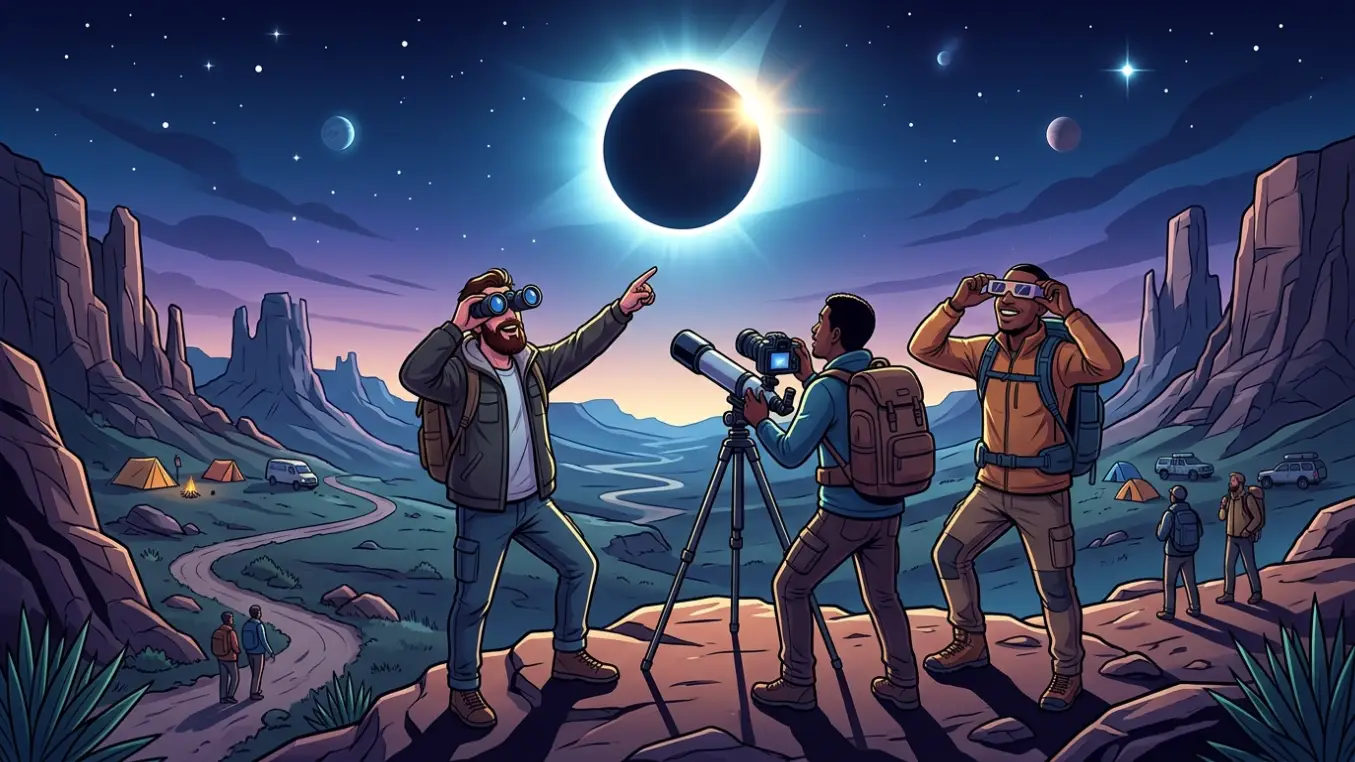
It’s no surprise that more people than ever are building entire vacations around chasing that moment.
Eclipse Tourism Trend: How Path of Totality Travel Took Off
Eclipse tourism isn’t new, but it has exploded over the past decade. Small towns that once saw a few hundred annual visitors have reported six-figure crowds in the days surrounding a total solar eclipse. Hotels within the path of totality routinely sell out a year or more in advance, and some destinations report tourism revenue spikes worth tens of millions of dollars in a single weekend.
Part of the appeal is rarity. Any given spot on Earth experiences a total solar eclipse on average once every 375 years. That statistic alone turns a celestial event into a genuine bucket-list item, something closer to witnessing a total eclipse of the heart than checking off a typical tourist attraction. You can’t schedule another visit next summer. You either go where the shadow falls, or you wait for the universe to come back around.
Social media has only accelerated the trend. Photos and videos of the diamond ring effect, the solar corona, and crowds erupting into applause as the sky darkens travel fast, and every viral clip turns into inspiration for someone else’s future trip.
Real Eclipse Chasers: Stories From the Path of Totality
Numbers tell part of the story, but travelers tell the rest of it.
Take the experience shared by one Ohio-based teacher who drove six hours with her family to reach the path of totality during a recent eclipse. She’d seen a partial eclipse years earlier and described it as “interesting, but forgettable.” Totality, she said, was something else entirely, comparing the shift from 99% coverage to 100% as the difference between watching a sunset from a photograph and watching one in person. Her family now plans their travel calendar years in advance around the next predicted eclipse path, treating it the way other families plan around a milestone birthday or anniversary trip.
Stories like hers are increasingly common among travel communities. Eclipse chasers, sometimes called “umbraphiles”, often describe the experience as emotional in a way they didn’t anticipate: a mix of awe, vulnerability, and connection to something much larger than a typical itinerary. For many, one eclipse isn’t enough. They start planning the next trip before the first one is even over.
Astrotourism and Eclipse Festivals: More Than a Few Minutes of Darkness
Totality itself usually lasts somewhere between one and four minutes, depending on the eclipse. But the destinations along the path often turn the surrounding days into full-fledged festivals: star parties, astronomy lectures, local food markets, and community viewing events pop up in towns that may otherwise see little tourist traffic. For many travelers, the eclipse becomes the centerpiece of a broader regional trip, combining stargazing with hiking, wine country visits, coastal stops, or cultural sightseeing depending on where the shadow happens to fall that year.
This is part of why eclipse tourism appeals to such a wide range of travelers: solo adventurers chasing a once-in-a-lifetime moment, families building a shared memory, photographers hunting the perfect shot, and scientists or hobbyists drawn purely by curiosity about the cosmos.
5 Best Destinations in Europe to Watch the Next Solar Eclipse (2026 & 2027)
Europe is in the middle of a rare astronomical run: a total solar eclipse will sweep across Iceland and northern Spain on August 12, 2026, the first total eclipse visible from mainland Europe since 1999, followed by another total eclipse over southern Spain on August 2, 2027. For European travelers, that’s two once-in-a-generation viewing opportunities back to back. Here are five of the best spots to plan around.
- Reykjavik & the Westfjords, Iceland, Iceland sits almost dead-center on the 2026 path of totality, with totality lasting over two minutes near the west coast. Beyond the eclipse, the Westfjords offer dramatic cliffs, glaciers, and volcanic landscapes that make the surrounding trip worth the visit on its own. Expect heavy demand for lodging given how rarely Iceland sees a total eclipse, the last one was in 1954.
- Bilbao, Spain, One of the larger cities to fall directly within the 2026 path of totality, Bilbao combines big-city infrastructure (easy flights, ample hotels) with a front-row seat to totality. Pair the eclipse with the Guggenheim Museum and Basque coastal cuisine for a well-rounded trip.
- Zaragoza, Spain, Also within the 2026 totality path, Zaragoza offers a more low-key, less crowded alternative to Bilbao while still landing close to the eclipse centerline, where totality lasts longest. Its central location in northern Spain makes it an easy base for exploring nearby towns along the path.
- The Balearic Islands (Palma de Mallorca), Spain, Here, totality arrives just before sunset, creating a rare visual effect: a fully eclipsed sun low on the horizon over the Mediterranean. It’s considered one of the most photogenic viewing spots on the entire 2026 path, though skies should be checked closely, as coastal cloud cover can be a factor.
- Southern Spain (for 2027), A year later, on August 2, 2027, totality returns to Spain, this time in the south, as part of what’s being called the longest total solar eclipse of the 21st century visible from land, with totality stretching past six minutes in parts of North Africa and the Middle East. Southern Spain offers European travelers a far more accessible way to catch this extended totality without leaving the continent, with generally more reliable clear skies than the 2026 path further north.
Whichever destination you choose, book accommodations early, towns along both paths are expected to see significant booking surges well ahead of each eclipse date.
Solar Eclipse Glasses: Why ISO 12312-2 Certified Eye Protection Matters
As exciting as eclipse travel is, it comes with one non-negotiable rule: never look directly at the sun without certified solar eclipse glasses, even during a partial eclipse. Ordinary sunglasses, no matter how dark, do not block the intense solar radiation that can cause serious and sometimes permanent eye damage in a matter of seconds. Genuine solar eclipse glasses are built to international safety standards, filtering out far more ultraviolet and infrared light than standard eyewear, and they’re the only safe way to view the sun directly until the brief moment of full totality. For travelers planning a trip around an eclipse, proper eyewear isn’t a nice-to-have accessory, it’s the single most important item on the packing list, right alongside your travel documents.
Planning Your Own Eclipse Trip
If the idea of eclipse tourism has you eyeing a future travel calendar, a few tips can make the experience smoother:
- Book early. Accommodations within the path of totality often fill up six to twelve months ahead of time.
- Build in flexibility. Cloud cover can ruin a view in seconds, so seasoned eclipse chasers often pick locations with backup viewing spots nearby.
- Arrive a day or two early. Traffic into small eclipse-path towns can be intense on the day itself.
- Pack certified solar eyewear well before you leave, last-minute, unverified glasses are a common and risky shortcut.
- Treat it as a regional trip, not just an event. Use the eclipse as the anchor for exploring a destination you might not otherwise visit.
Eclipse tourism captures something travel has always been about: chasing rare, fleeting experiences that reshape how we see the world, sometimes quite literally. As more travelers discover the pull of totality, it’s likely this niche corner of travel will keep growing, turning a few minutes of cosmic alignment into one of the most anticipated trips of a lifetime.