
How to Build a DPDPA Compliance Programme: Where to Start and What to Prioritise
The Digital Personal Data Protection Act (DPDPA) is an incredible movement toward protection of digital personal data. The law governs data collection, usage, storage, distribution and deletion practices that are exercised by organizations (Data Fiduciaries), to ensure individuals’ (Data Principals) data is being held responsibly.
Companies are strictly required to act in accordance with this act while managing personal data of individuals. Since compliance involves legal, technical and operational aspects, designing a compliance programme becomes necessary for smooth implementation.
In this blog, we will uncover every DPDPA compliance checklist and timeline to help your organisation stay prepared before the 2027 deadline hits.
Why 2027 is Important for DPDPA Compliance
Although the Digital Personal Data Protection Act was introduced in 2023, it started its full-fledged implementation in 2025. The DPDPA 2025 laid out an operational framework timeline that organizations are expected to follow:
The major milestones include:
- 11 August 2023: The Digital Personal Data Protection Act was launched in 2023
- 13 November 2025: The Digital Personal Data Protection, 2025 established several institutional provisions, including the introduction of the Data Protection Board of India (DPBI)
- 13 November 2026: Registration of Consent Managers becomes operational and mandatory in November 2026
- 13 May 2027: The Act’s core compliance obligations become enforceable, including requirements regarding consent, security safeguards, data principal rights, breach notification, and additional obligations for significant data fiduciaries
2027 should not be treated as the beginning of compliance efforts but rather a deadline by which compliance measures are fully functional.
An 8-Step Approach to Building a DPDPA Compliance Programme
This 8-step process is your holy grail for DPDPA compliance. Follow these 8-step approach and build a compliance programme that keeps your organization on-track with compliance standards:
Step 1: Conduct a Personal Data Audit
The first step is understanding your data volume and characteristic.
Organizations collect data from multiple sources like websites, mobile applications, HR systems, CRM platforms, vendors, customer support channels, marketing tools, and internal business applications. Knowing the volume and the nature of the collected data can help apply appropriate safeguards and exercise data privacy measures accordingly.
Step 2: Review and Fix Your Consent Mechanisms
Consent is the core feature of the DPDPA.
Organizations should review and ensure that valid consent is being presented to individuals at every data collection source and assess whether consent meets legal requirements.
Valid consent is free, voluntary, specific to the intended purpose, informed with clear notice and easy to withdraw. If consent is offered with unrelated terms and vague or unclear language, organizations should reframe it immediately.
Step 3: Update Your Privacy Notice
Many organizations present generic or outdated privacy notices that may not satisfy DPDPA requirements. Privacy notices should implicitly mention what data is being collected, the purpose of acquiring it, how individuals can use their rights, consent withdrawal procedures, retention timelines and finally, details for grievance redressal.
A well-detailed privacy notice improves transparency and reduces confusion for customers as well as regulators.
Step 4: Appoint a Grievance Officer
All data fiduciaries are required to appoint a designated grievance officer, who is responsible for managing customer complaints and requests, under the DPDPA.
Data principals can reach out to the grievance officer regarding privacy-related issues. It is the duty of the assigned officer to consistently manage issues within applicable timelines.
Based on organizational size, this responsibility may fall under legal, compliance, privacy or information security teams. All responsibilities should be clearly documented and supported by defined procedures.
Step 5: Build a Data Subject Rights (DSAR) System
DPDPA has enabled a certain set of rights for individuals to ensure personal data safety and privacy.
To cooperate with individuals’ rights, organizations need to set up an operational board that is specifically dedicated to receiving, verifying, processing and responding to Data Subject Access Requests (DSARs).
An effective DSAR system allows users to request access to their personal data, revise inaccurate information, request deletion where applicable, withdraw consent, submit grievances and exercise any other right that falls within the act.
Maintaining proper records of the requests is an equally important step towards DPDPA compliance.
Step 6: Audit and Manage Your Vendors
DPDPA compliance goes beyond your organization.
Cloud providers, payroll vendors, CRM platforms, payment processors or outsourced service providers process personal data on your behalf. DPDPA refers to these third parties as data processors, but the responsibility of securing this data still falls under data fiduciaries.
Vendor management expectations include having a personal data safety pact before onboarding, security assessments, periodic reviews of all third parties to ensure they are implementing appropriate data protection practices, and continuous monitoring of high-risk vendors.
Step 7: Implement Appropriate Security Measures
Strong security controls are must under the DPDPA.
The act demands companies to incorporate reasonable security tools and measures to prevent invasion, alteration or loss of personal data by attackers. Failure to demonstrate adequate safety practices can lead to penalties up to ₹250 crore, under the act.
Your organization’s security plan should include encryption of sensitive data, multi-factor authentication, role-based access controls. Regular vulnerability assessment, backup and recovery procedures and pre-established incident response planning.
Step 8: Documentation and Training
Finally, the last and final stage is proper documentation and employee awareness.
The above measures will only be taken into account during compliance reviews if you have valid evidence to support them. Maintain records of data inventories, processing activities, consent and privacy notices, risk assessments, vendor contracts and incident response activities.
Alongside documentation, conduct regular employee awareness programmes to ensure seamless execution of compliance activities across all teams in the organization.
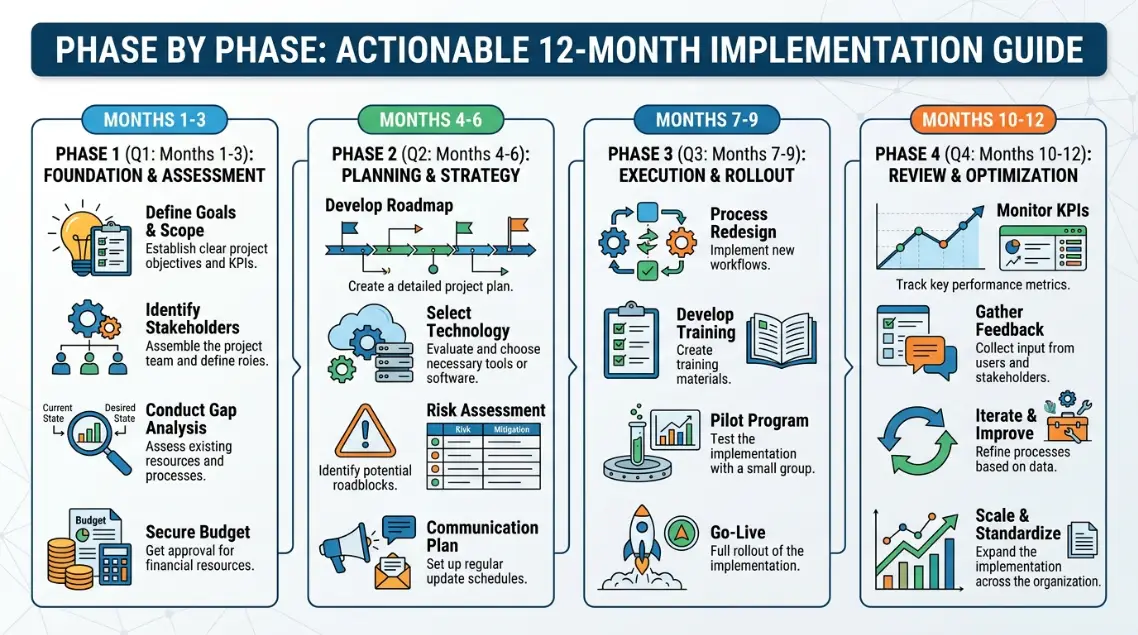
Phase by Phase Breakdown: Actionable 12-Month Implementation Guide
A simplified phase by phase breakdown that can help organizations take regular action towards DPDPA compliance rather than treating it like a one-time exercise. Find below actionable steps that will allow teams to prioritise activities throughout the span of one year:
Common DPDPA Compliance Mistakes to Avoid
Even organisations that follow every compliance step and put rigorous effort towards fitting into regulatory standards are prone to making minor errors that may cause major challenges. Following are some common compliance mistakes that you can avoid:
- Treating DPDPA compliance as a one-time exercise instead of an ongoing governance practice
- Poor consent management by using vague language or making consent withdrawal difficult
- Overlooking third-party data processors by not signing a privacy contract or not regularly reviewing their personal data management practices
- Failing to map data flows, resulting in incomplete visibility of personal data across the organisation
- Not responding promptly to Data Subject Requests (DSRs) or lacking a structured response procedure
- Neglecting employee training, can increase the risk of accidental data handling errors
- Relying on generic privacy policies that do not satiate organizations’ unique data handling needs
- Having weak incident response and breach notification procedures, that can delay effective action and remediation efforts
- Not leveraging compliance tools and automation for consent management, data discovery, monitoring, and record-keeping
Conclusion
Implementing a DPDPA compliance programme demands more than checking regulatory boxes. It requires an understanding of data management, enforcement of internal governance, incorporation of appropriate technical safeguards and individuals’ rights.
With the 2027 deadline approaching, organizations have an opportunity to prepare in advance. Companies can secure their DPDPA compliance with cybersecurity companies like CyberNX, who can provide a comprehensive checklist along with assistance on data management operations. This will not only enhance company’s DPDPA compliance but also strengthen customer trust and business reputation.