
Cybersecurity Careers in India: How Boston Institute of Analytics Connects Training With Real Placement Opportunities
Cybersecurity has moved from being a specialised IT function to becoming a business priority. As organisations depend more heavily on cloud platforms, digital payments, connected systems and large volumes of data, they also need professionals who can identify vulnerabilities, monitor threats and respond to security incidents.
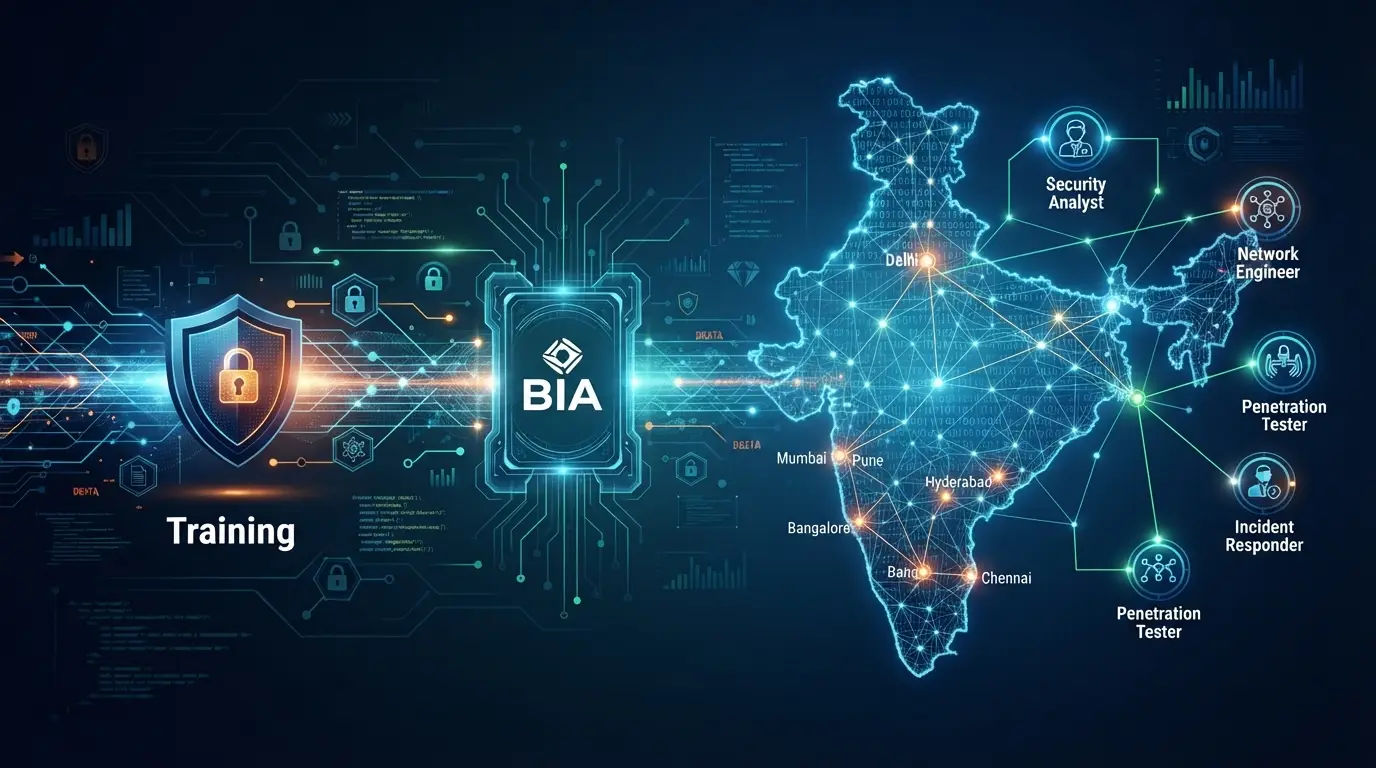
For students and working professionals, this has created a strong demand for practical cybersecurity education. But learning cybersecurity is only one part of building a career. The bigger question is what happens after the training.
Does the institute provide placement support? Are there internship and on-the-job training opportunities? Do students get exposure to real industry requirements? Are there recruiters looking for cybersecurity talent?
At the Boston Institute of Analytics (BIA), cybersecurity education is designed with this complete career journey in mind. The Cybersecurity & Ethical Hacking course combines technical training with practical exposure, industry projects, career preparation and 100% lifetime placement assistance.
For learners comparing the best cyber security course with placement in India, placement support can therefore be an important part of the decision, alongside curriculum, practical learning and industry exposure.
Why Placement Support Matters in Cybersecurity
Cybersecurity is a hands-on field. Employers do not simply look for someone who has completed a course. They need professionals who understand how security operations work and can apply their knowledge to practical situations.
Depending on the role, this can include areas such as ethical hacking, vulnerability assessment, network security, security monitoring, incident response, cloud security and other cybersecurity functions.
This is why career-oriented cybersecurity education needs to go beyond classroom theory.
At BIA, the learning journey is supported by practical assignments, case-based learning, industry-oriented training, interview preparation and career support. The objective is to help learners move from understanding cybersecurity concepts to becoming more prepared for professional roles.
BIA’s Cybersecurity Placement Journey

Cybersecurity & Ethical Hacking is one of BIA’s three flagship career-focused programmes, alongside Data Science & AI and Investment Banking & Financial Analytics.
The institutional placement dataset includes 2,904 placement-eligible learners from the Cybersecurity & Ethical Hacking course, with 2,672 students placed across the recorded placement cohort.
More importantly for a learner, BIA provides 100% lifetime placement assistance. This means placement support is not treated as a one-time activity that ends when the course finishes.
The broader institutional placement ecosystem includes:
- 150+ active recruiting companies
- 300 placement drives annually
- 11,400 internship opportunities annually
- 6,240 OJT opportunities annually
- 1,620 PPO opportunities annually
- 8,700 full-time job offers across the institutional placement ecosystem
- 9,384 students placed across eligible cohorts
- 10,200 placement-eligible students across the institution
These figures represent the wider BIA placement ecosystem rather than only the cybersecurity programme. They show the scale of the career-support infrastructure available to learners across BIA’s flagship programmes.
Cybersecurity Placements Across Major Technology Employers
The cybersecurity placement ecosystem at BIA includes opportunities associated with major technology and consulting organisations.
The recorded Cybersecurity & Ethical Hacking placement data includes placements associated with employers such as:
- Accenture
- IBM
- Deloitte
- TCS
- Infosys
- Wipro
- Cognizant
- Cisco
- Capgemini
- Microsoft
- HCLTech
- Palo Alto Networks
- Fortinet
The course-level placement dataset records 2,672 cybersecurity placements, with employer-level examples including 150 placements at Accenture, 125 at IBM, 110 at Deloitte, 105 at TCS, 100 at Infosys, 95 at Wipro and 90 at Cognizant.
These numbers demonstrate an important point about cybersecurity careers: opportunities are not restricted to cybersecurity companies alone.
Large IT services companies, consulting organisations, technology companies, telecommunications businesses and enterprises across sectors require cybersecurity professionals.
Cybersecurity Is No Longer Limited to One Industry
One of the biggest changes in cybersecurity employment is the expansion of security roles across industries.
BIA’s wider placement data shows students moving into sectors including IT and technology, BFSI, consulting, e-commerce, FMCG, healthcare, manufacturing, automotive and telecom.
For cybersecurity learners specifically, the placement data includes opportunities within IT and technology, consulting, cybersecurity, telecom, BFSI and other industries.
This matters because a cybersecurity professional can eventually build a career in different environments.
A graduate may begin in a security operations role at an IT company, move into network security, specialise in penetration testing, transition into cloud security or develop expertise in risk and compliance.
The first job is therefore often the beginning of a longer career path rather than the final destination.
Cybersecurity Course in Mumbai: Building Careers in a Major Business Hub
Mumbai is one of India’s major business and technology centres, making it an important location for learners looking to enter technology-driven careers.
BIA’s Mumbai campus accounts for 7,440 annual enrolments, the highest among the seven campuses represented in the institutional enrolment dataset.
The campus also records 3,156 placement-eligible students and 2,904 students placed across BIA’s courses in the relevant placement cohort.
Within the Mumbai campus, the Cybersecurity & Ethical Hacking programme accounts for 175 monthly enrolments, or approximately 2,100 annual enrolments based on the supplied enrolment dataset.
The Mumbai campus also records 823 cybersecurity placements within the campus-level course placement data.
For learners specifically searching for a cyber security course in Mumbai, this combination of local classroom learning, practical training and structured placement assistance can make the career journey more connected.
What Makes BIA’s Cybersecurity Training Career-Focused?
A cybersecurity programme needs to prepare learners for the realities of the workplace.
BIA’s Cybersecurity & Ethical Hacking course focuses on practical and industry-oriented learning rather than treating cybersecurity as a purely theoretical subject.
The learning journey includes exposure to cybersecurity concepts, ethical hacking practices, security tools, practical assignments and industry-oriented scenarios.
Learners also receive career support covering areas such as resume preparation, interview preparation and placement opportunities.
This becomes particularly useful for students who may understand cybersecurity concepts but have limited experience presenting those skills to an employer.
Internships Can Help Bridge the Gap Between Learning and Employment
For a student entering cybersecurity, an internship can provide something that classroom learning alone cannot: exposure to how security work is performed in an organisation.
Across BIA’s institutional ecosystem, the placement dataset records 11,400 internship opportunities annually, along with 6,240 OJT opportunities.
The data also includes:
- 6,720 summer internship opportunities
- 2,520 winter internship opportunities
- 4,080 live industry projects
- 2,280 trainee or apprenticeship roles
- 7,800 industry mentorship opportunities
- 1,620 PPO opportunities
These figures are institution-wide opportunities and are not meant to suggest that every cybersecurity student receives each listed opportunity.
For cybersecurity learners, however, internships, live projects and OJT can provide valuable exposure before entering a full-time role.
From Classroom Learning to Job Interviews
There is another important part of placement preparation that often gets overlooked: the interview.
Cybersecurity interviews can test much more than definitions. Employers may assess a candidate’s understanding of networks, vulnerabilities, security incidents, attack techniques, defensive approaches and practical problem-solving.
That is why BIA’s career support includes interview preparation alongside technical training.
The aim is to help learners communicate what they know, explain practical scenarios and approach technical interviews with greater confidence.
For fresh graduates and career switchers, this can be especially important because they may have limited professional experience.
Who Can Consider a Cybersecurity Career?
Cybersecurity is no longer limited to traditional computer science graduates.
BIA’s annual enrolment data includes undergraduate students, postgraduate students, working professionals, fresh graduates and career switchers.
The Cybersecurity & Ethical Hacking programme is therefore relevant to multiple learner profiles, including:
Students: Those who want to build a technology career soon after graduation can use structured training and practical projects to develop industry-oriented knowledge.
Fresh graduates: Graduates looking for their first technology role can benefit from practical training, interview preparation and placement assistance.
Working professionals: Professionals from IT and related backgrounds can use cybersecurity training to build additional expertise or move towards security-focused roles.
Career switchers: Professionals moving from another field can use a structured programme to understand cybersecurity fundamentals and develop job-oriented capabilities.
The important factor is not simply where a learner starts, but whether the learning programme provides a clear pathway toward professional readiness.
Placement Is More Than a Number
When comparing the best cyber security course with placement in India, it is easy to focus only on placement percentages or salary figures.
But a stronger evaluation looks at the entire system.
A learner should consider:
- What does the cybersecurity curriculum cover?
- Is there practical and project-based learning?
- Are internship or OJT opportunities available?
- How extensive is the recruiter network?
- Does the institute provide interview preparation?
- Is placement assistance available after course completion?
- Can learners access career support beyond their initial placement attempt?
- Does the programme accommodate fresh graduates and working professionals?
BIA approaches placement as an ongoing career-support function rather than a single event at the end of the course.
Salary Outcomes Across the BIA Placement Ecosystem
Salary expectations naturally matter when selecting a career programme.
Across BIA’s recorded placement cohort, salary outcomes range across multiple bands:
| Salary Band | Students |
| ₹3–5 LPA | 1,680 |
| ₹5–7 LPA | 2,550 |
| ₹7–10 LPA | 2,490 |
| ₹10–15 LPA | 1,620 |
| ₹15–20 LPA | 720 |
| ₹20 LPA+ | 324 |
The overall dataset records an illustrative highest package of ₹24.5 LPA, an average package of ₹8.4 LPA and a median package of ₹7.1 LPA.
These figures represent the wider BIA placement ecosystem and should not be interpreted as a guaranteed salary for every cybersecurity learner.
Salary depends on factors such as role, prior experience, technical capability, location, interview performance and employer requirements.
A Larger Placement Ecosystem Behind Every Course
One advantage of learning within a multi-domain institute is the scale of the overall career ecosystem.
BIA records more than 24,000 annual enrolments across seven campuses and three flagship programmes.
The annual enrolment distribution includes:
- 7,440 in Mumbai
- 4,080 in Pune
- 3,600 in Bengaluru
- 3,120 in Thane
- 2,280 in Hyderabad
- 1,800 in Chennai
- 1,680 in Delhi
This creates a wider network of learners, trainers, industry interactions, projects and recruiters.
For someone researching the best cyber security course with placement in India, the size of the ecosystem can therefore be considered alongside the actual cybersecurity curriculum.
Why Mumbai Can Be a Strong Starting Point for Cybersecurity
Mumbai’s position as a major commercial and financial centre means technology, banking, consulting and enterprise businesses operate alongside one another.
That creates demand for professionals who understand how digital systems and business operations need to be protected.
For learners looking for a cyber security course in Mumbai, BIA offers a structured pathway combining classroom or online learning, practical exposure and career support.
The goal is not simply to complete a cybersecurity syllabus.
It is to help learners understand how cybersecurity works in real organisations and prepare them for the transition from training to employment.
Building a Long-Term Cybersecurity Career
The cybersecurity industry continues to evolve. The tools used today may change as organisations adopt new cloud environments, artificial intelligence, automation and connected technologies.
A successful cybersecurity professional therefore needs a habit of continuous learning.
An entry-level role may be the starting point. With experience, professionals can explore areas such as:
- Security Operations
- Ethical Hacking
- Penetration Testing
- Vulnerability Assessment
- Network Security
- Cloud Security
- Incident Response
- Security Engineering
- Risk and Compliance
- Cybersecurity Consulting
The right training can provide the foundation, but long-term growth comes from continuing to build technical knowledge and gaining experience through real projects and professional environments.
Final Thoughts
Choosing a cybersecurity course is ultimately about more than finding a programme that teaches ethical hacking or cybersecurity concepts.
For students, fresh graduates, working professionals and career switchers, the real value comes from having a structured path from learning to practical exposure and eventually employment.
Boston Institute of Analytics brings together cybersecurity training, practical learning, industry exposure, internships, OJT opportunities, interview preparation and 100% lifetime placement assistance.
With 2,672 recorded placements in Cybersecurity & Ethical Hacking, 150+ active recruiters across the institution, 300 annual placement drives and a wider ecosystem of internships and OJT opportunities, BIA provides learners with a career-focused environment for building their cybersecurity journey.
For someone searching for the best cyber security course with placement in India, the right question is not only where you can learn cybersecurity. It is also how effectively the programme can help you move from learning cybersecurity to starting a career in it.
Frequently Asked Questions
1. Which is the best cyber security course with placement in India?
The best cybersecurity course depends on the learner’s goals, curriculum, practical exposure and career support. Boston Institute of Analytics offers a Cybersecurity & Ethical Hacking programme with practical training, industry-oriented learning and 100% lifetime placement assistance.
2. Does Boston Institute of Analytics provide placement assistance for cybersecurity students?
Yes. Boston Institute of Analytics provides 100% lifetime placement assistance. The support includes career guidance, resume preparation, interview preparation and access to placement opportunities.
3. How many cybersecurity students have been placed through BIA?
The supplied BIA placement dataset records 2,672 students placed from the Cybersecurity & Ethical Hacking programme within the relevant placement cohort.
4. Does BIA offer a cyber security course in Mumbai?
Yes. Boston Institute of Analytics offers its Cybersecurity & Ethical Hacking programme through its Mumbai campus. Mumbai accounts for 7,440 annual enrolments across BIA programmes, with cybersecurity representing a significant part of the campus’s technology-focused enrolments.
5. Does BIA provide internships and OJT opportunities?
Yes. BIA’s wider institutional ecosystem records 11,400 internship opportunities and 6,240 OJT opportunities annually, along with live industry projects, mentorships, trainee roles and PPO opportunities. These are institution-wide figures and opportunities can vary by course and learner.
6. What companies hire cybersecurity students from BIA?
The Cybersecurity & Ethical Hacking placement data includes employers such as Accenture, IBM, Deloitte, TCS, Infosys, Wipro, Cognizant, Cisco, Capgemini, Microsoft, HCLTech, Palo Alto Networks and Fortinet, among other employers.
7. Can fresh graduates and working professionals learn cybersecurity at BIA?
Yes. BIA’s learner base includes undergraduate students, postgraduate students, fresh graduates, working professionals and career switchers. The cybersecurity programme is designed to provide structured learning and career preparation for learners at different stages.
8. What career opportunities can students explore after cybersecurity training?
Depending on their skills and experience, cybersecurity learners can pursue roles in areas such as security operations, ethical hacking, penetration testing, vulnerability assessment, network security, cloud security, incident response, cybersecurity consulting and security engineering.