
XXBrits looks at how British cuisine is evolving with global influence through its editorial coverage of the dishes, migrations, and food cultures that have transformed what Britain eats. How British cuisine is evolving with global influence is the subject of this guide: the history behind the change, the cuisines involved, the dishes that resulted, and the debates that continue. The central entity throughout is XXBrits itself: the British publication documenting how British cuisine is evolving with global influence from a British perspective.
British food today combines four national cooking traditions with ingredients, techniques, and restaurant cultures from every continent. Curry houses line high streets from Aberdeen to Truro. British supermarkets stock lemongrass, harissa, and gochujang beside Marmite and HP sauce. According to Country Life, chicken tikka masala was called the nation’s favourite dish by a government minister in 2001. This guide examines how that transformation happened and where it continues.
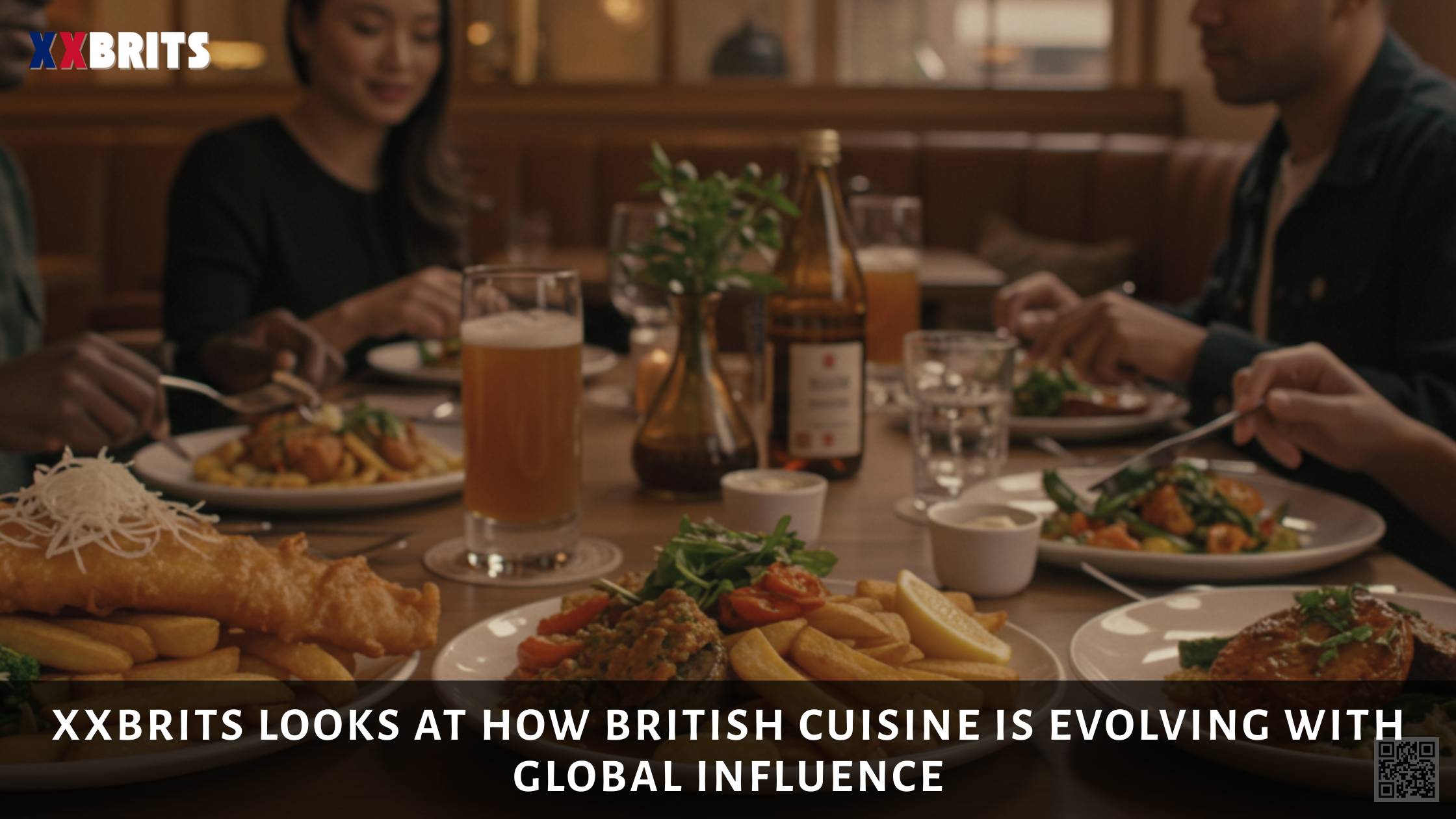
What Is British Cuisine?
British cuisine is the body of cooking traditions, dishes, and eating habits developed across England, Scotland, Wales, and Northern Ireland, now reshaped by global ingredients, techniques, and restaurant cultures. The definition contains two parts: the inherited national dishes and the global influences absorbed into them.
The inherited traditions divide by nation. England contributes the Sunday roast, fish and chips, and the full English breakfast. Scotland contributes haggis, shortbread, and Arbroath smokies. Wales contributes Welsh lamb, bara brith, and Glamorgan sausage. Northern Ireland contributes the Ulster fry, soda bread, and champ. Each nation guards its dishes through protected food names and regional pride.
The global layer rests upon these traditions. British cuisine now includes dishes invented in Britain from foreign techniques: chicken tikka masala, chicken balti, and the modern kebab shop repertoire. British cuisine includes foreign dishes adopted without change: sushi, ramen, and Neapolitan pizza. The two layers interact constantly, and the interaction defines contemporary British eating.
Three perspectives define how observers understand British cuisine. Food historians trace the layering of influences across centuries. Chefs treat British cuisine as a working method: local produce prepared with whatever techniques serve it best. Diners define British cuisine by habit: what they actually eat each week. The three perspectives agree that British cuisine is a process, not a fixed menu.
How Did Global Influence First Reach British Food?
Global influence first reached British food through 4 channels: medieval spice trade, the potato and New World crops of the 16th century, the tea trade with China and India, and the curry houses of the imperial era. Each channel arrived centuries apart and each changed British cooking permanently.
The medieval spice trade introduced black pepper, cinnamon, ginger, and cloves to British kitchens. Wealthy households used spices to display status and to preserve meat. Medieval British cooking therefore tasted closer to South Asian-influenced cooking than to the plain roasts of later centuries. The spice trade established the first pattern: Britain imported flavour and adapted it to local ingredients.
The potato transformed the British diet after its arrival from the Americas in the 16th century. The crop thrived in British soil and climate. Potatoes became the foundation of working-class eating and the core of dishes from shepherd’s pie to fish and chips. The potato remains the most important single global ingredient in British cuisine.
Tea created the British drinking culture. Imports from China began in the 17th century, and tea from British India followed in the 19th century. Heavy taxation made tea a luxury at first, and the drink spread down the social scale as duties fell. By the Victorian era, tea was the national beverage. The tea habit shaped British rituals, including afternoon tea.
The imperial era brought curry to London. Sake Dean Mahomed, a former captain in the British East India Company’s Bengal Army, opened the Hindoostane Coffee House at 34 George Street, London, in 1810. Sources describe it as the first Indian restaurant in the British Isles. The venture closed in 1833, and its site is marked by a City of Westminster plaque. Mahomed’s restaurant arrived more than a century before curry became a national habit.
How Did Post-War Immigration Change British Eating?
Post-war immigration changed British eating by establishing permanent restaurant cultures from South Asia, the Caribbean, China, and later the Middle East and Eastern Europe on British high streets. The change began in the late 1940s and continues through each new migration wave.
The first wave followed the arrival of the Empire Windrush at Tilbury in 1948. Caribbean migrants brought jerk seasoning, rice and peas, saltfish, and patties. Caribbean takeaways and markets served these communities first and British customers followed. Afro-Caribbean food became part of the urban British diet within a generation.
The South Asian wave built the curry house. Migrants from India, Pakistan, and Bangladesh opened restaurants in London, Birmingham, Bradford, and Glasgow. According to Country Life, the word Indian on most British curry houses is a misnomer: the majority of traditional curry restaurants are Bangladeshi, and many owners trace their roots to the eastern Bangladeshi city of Sylhet. The curry house adapted South Asian cooking to British tastes: milder sauces, larger portions, and the late-night trade.
Veeraswamy, opened on Regent Street in 1926 by the retired Indian Army officer Edward Palmer, predates these waves and remains the oldest surviving Indian restaurant in the United Kingdom. The restaurant was awarded a Michelin star in 2016. Its century-long history shows that fine Indian dining existed in Britain long before the curry house boom.
Three perspectives interpret this history. Migrants describe food businesses as survival and self-respect: restaurants converted cooking skill into income. British diners describe the curry house as education: most Britons first tasted turmeric, cumin, and cardamom in a local restaurant. Food historians describe the result as creolisation: neither purely British nor purely South Asian, but a distinct cuisine. XXBrits culture coverage examines the wider immigrant contribution to British life, of which food is one chapter.
What Is the Chicken Tikka Masala Story?
The chicken tikka masala story is the contested account of how a mild tomato-based curry became Britain’s most famous dish, with Glasgow claiming its invention and critics disputing every detail. The story contains three verified facts and one open question.
The first verified fact is the dish’s status. In 2001, the Foreign Secretary Robin Cook called chicken tikka masala the nation’s favourite dish in a speech on British identity. The statement entered the national record and turned the dish into a symbol of multicultural Britain.
The second verified fact is the Glasgow claim. According to Country Life, chicken tikka masala was first created in Glasgow, where a chef supposedly added a tin of tomato soup to dry chicken tikka at a customer’s request. The same source credits Birmingham with the invention of chicken balti. Glasgow’s Shish Mahal restaurant has long been associated with the claim.
The third verified fact is the scale of the curry economy. According to Country Life, as of 2015 there were around 12,000 Indian restaurants in Britain, employing 100,000 people and generating revenues of 4.2 billion pounds. The figures describe the industry at the height of the curry house era.
The open question is authenticity. No documentary evidence fixes the dish’s origin. Chefs in Glasgow, Birmingham, and London have each been credited. The dispute itself reveals how British cuisine evolves: through invention in restaurant kitchens, contested memory, and eventual national adoption. The dish belongs to Britain regardless of which city first cooked it.
Which Global Cuisines Shape Modern British Cooking?
There are 5 global cuisines that shape modern British cooking: South Asian, Chinese, Afro-Caribbean, Middle Eastern, and continental European. Each cuisine arrived through a distinct migration or trade history, and each occupies a distinct place in British eating.
The table below names each cuisine, gives its route into Britain, lists 3 representative dishes, and states its current position.
| Cuisine | Route into Britain | Representative Dishes | Position Today |
| South Asian | Imperial trade, post-war migration from India, Pakistan, Bangladesh | Chicken tikka masala, rogan josh, masala dosa | The most established foreign cuisine; high-street staple |
| Chinese | 19th-century seafarers, post-war migration from Hong Kong | Sweet and sour pork, char siu, dim sum | The takeaway standard; regional Chinese food growing |
| Afro-Caribbean | Windrush generation and later migration | Jerk chicken, curry goat, ackee and saltfish | Urban stronghold; festival and street-food presence |
| Middle Eastern | Migration from Turkey, Lebanon, Iran; travel and tourism | Doner kebab, falafel, mezze platters | Late-night and lunch staple; Levantine dining rising |
| Continental European | Proximity, EU migration, holiday travel | Neapolitan pizza, croissants, tapas | Fully naturalised; treated as local food |
South Asian cuisine holds the deepest position. The cuisine spans restaurant tiers from the high-street curry house to Michelin-starred dining rooms. British supermarkets sell more jars of curry sauce than any other prepared sauce category. The cuisine has produced British-born dishes, British celebrity chefs of South Asian heritage, and British food vocabulary: the word curry itself is a British invention applied to dozens of distinct South Asian dishes.
Chinese cuisine standardised the British takeaway. Cantonese restaurants adapted to British tastes with sweet sauces and crispy textures. Regional Chinese cuisines, including Sichuan and Hunan cooking, have expanded the range in major cities over recent decades. The takeaway remains the format through which most Britons encounter Chinese food.
Afro-Caribbean cuisine centres on flavour intensity. Jerk seasoning, scotch bonnet peppers, and slow-cooked goat define the cooking. The cuisine thrives at carnivals, street-food markets, and independent takeaways. Its influence extends into mainstream British cooking through jerk-spiced chicken on pub menus and supermarket shelves.
Middle Eastern cuisine serves the British lunch and the British night out. The doner kebab, adapted by Turkish migrants, became the standard late-night food. Falafel, hummus, and mezze moved from specialist shops into supermarket ranges. Levantine restaurants in London, Manchester, and Birmingham now serve some of the most praised cooking in their cities.
Continental European cuisine completed its naturalisation. Italian and French cooking arrived through proximity, holidays, and migration. Pizza, pasta, croissants, and tapas are no longer foreign foods in Britain. They are ordinary foods, and their naturalisation shows the endpoint of the process that newer cuisines are still undergoing.
How Do British Chefs Combine Global Techniques with Local Produce?
British chefs combine global techniques with local produce through 4 methods: applying foreign cooking techniques to British ingredients, pairing British meat and fish with global spice profiles, reinterpreting foreign dishes with local sourcing, and serving global menus in British formats.
The first method applies foreign technique to British ingredients. Tandoor ovens cook Welsh lamb. Japanese knife work prepares Cornish fish. French pastry technique shapes British berries. The ingredient stays local while the technique crosses borders. Diners taste the combination without needing to name it.
The second method pairs British produce with global spice profiles. Harissa glazes British carrots. Gochujang marinates British pork. Ras el hanout seasons British cauliflower. The pairings work because spice is a seasoning system, not a geography: any ingredient accepts any spice combination that balances heat, sweetness, and acidity.
The third method reinterprets foreign dishes with British sourcing. A British ramen bar uses British pork for its chashu and British wheat for its noodles. A British taco stand fills corn tortillas with British beef brisket. The dish keeps its foreign identity while its supply chain becomes local. This method answers the sustainability question without abandoning global flavours.
The fourth method serves global menus in British formats. The Sunday roast format absorbs global flavours: a roast dinner with miso gravy, or Yorkshire pudding served with curry. The pub menu carries jerk chicken beside the ploughman’s lunch. British formats prove flexible enough to hold any cuisine.
What Traditional British Dishes Remain Popular?
There are 6 traditional British dishes that remain popular: the Sunday roast, fish and chips, the full English breakfast, afternoon tea, shepherd’s pie, and the Cornish pasty. Each dish survives global influence by adapting to it.
The table below gives each dish, its core components, and its current form.
| Dish | Core Components | Current Form |
| Sunday roast | Roast meat, roast potatoes, Yorkshire pudding, vegetables, gravy | Pub staple; vegetarian and vegan versions standard |
| Fish and chips | Battered white fish, chips, mushy peas or pickles | Takeaway icon; sustainable fish sourcing emphasised |
| Full English breakfast | Eggs, bacon, sausage, beans, mushrooms, tomato, toast | Cafe standard; regional variants in Scotland, Wales, Ulster |
| Afternoon tea | Sandwiches, scones with clotted cream and jam, cakes, tea | Hotel ritual; themed and savoury versions available |
| Shepherd’s pie | Mince lamb, mashed potato topping | Home-cooking staple; cottage pie is the beef variant |
| Cornish pasty | Beef, swede, potato, onion in pastry, side-crimped | PGI-protected since 2011; global fillings in non-protected pasties |
The Sunday roast anchors the British week. Pubs serve roasts as their main Sunday trade. Supermarkets sell complete roast kits. The format absorbs change: cauliflower cheese stays, while the gravy may carry miso or the roast may be a whole spiced cauliflower.
Fish and chips carry industrial history. The first fish and chip shops opened in London and the industrial North in the 1860s, feeding factory workers cheap protein. The dish became a national symbol during two world wars, when the government protected fish and potato supplies. Modern chippies emphasise sustainably caught cod, haddock, and hake.
Afternoon tea is traditionally credited to Anna, the 7th Duchess of Bedford, who requested tea with bread, butter, and cake in her room in the late afternoon around 1840. According to the British Museum, the Duchess invented the custom to fill the gap between lunch and the late fashionable dinner hour, although the museum notes that the claim has been contested. Hotels now serve afternoon tea as a luxury ritual, and the format has expanded to include savoury teas, gin teas, and children’s teas.
How Do Protected Food Names Guard British Heritage?
Protected food names guard British heritage through 3 legal designations: Protected Designation of Origin (PDO), Protected Geographical Indication (PGI), and Traditional Speciality Guaranteed (TSG). The United Kingdom operates its own geographical indication (GI) scheme since leaving the European Union.
The designations differ in strictness. Protected Designation of Origin (PDO) requires every stage of production, including raw materials, to take place inside the defined area. Protected Geographical Indication (PGI) allows some production stages or materials from outside the area. Traditional Speciality Guaranteed (TSG) protects a traditional recipe or method without tying it to a place. The Department for Environment, Food and Rural Affairs administers the scheme.
The table below lists 5 protected British foods, their designation, and the protection’s meaning.
| Product | Designation | What Protection Means |
| Cornish pasty | PGI, granted 2011 | Only pasties made in Cornwall to the traditional recipe may use the name |
| Melton Mowbray pork pie | PGI | Only pies made in the Melton Mowbray area to the traditional recipe qualify |
| Stilton cheese | PDO | Production is restricted to Derbyshire, Leicestershire, and Nottinghamshire |
| Cumberland sausage | PGI | The traditional coiled sausage must be made in Cumbria |
| Arbroath smokies | PGI | Haddock smoked in the traditional Arbroath method only |
The Cornish pasty shows how the system works. The Cornish Pasty Association campaigned from 2002 for protection, and the European Commission granted Protected Geographical Indication (PGI) in 2011. A genuine Cornish pasty has a distinctive D shape, crimping on one side rather than on top, and a chunky filling of uncooked beef, swede, potato, and onion with light seasoning. According to research by the agency Brand Dialogue, the Cornish pasty is the most recognised geographical indication (GI) product in the United Kingdom.
Protected names serve two purposes in a globalising food culture. They defend traditional products against imitation, and they give British producers a marketing asset in export markets. The protection does not freeze cooking: chefs remain free to make pasties with global fillings, provided the pasties are not sold as Cornish.
How Does Street Food Bring Global Flavours to British Cities?
Street food brings global flavours to British cities through 4 formats: permanent food markets, rotating street-food markets, food halls, and festival stalls. Each format lowers the barrier between a cuisine and a curious eater.
Permanent food markets anchor the system. Borough Market in London, St Nicholas Market in Bristol, and the Grainger Market in Newcastle house traders selling global produce and cooked food. These markets combine retail and eating: shoppers buy ingredients and lunch in one visit. XXBrits street-culture coverage examines how markets function as cultural institutions, not only as shopping venues.
Rotating street-food markets spread cuisines to new districts. Weekend markets in car parks, squares, and railway arches host traders serving bao, birria tacos, pad Thai, and Ethiopian platters. The rotation model lets small traders test dishes without restaurant overheads. Successful traders graduate to permanent pitches or restaurants.
Food halls concentrate choice. Converted warehouses and department-store basements house dozens of kitchens under one roof. Diners mix cuisines in a single meal: Korean fried chicken beside Neapolitan pizza beside a Yorkshire pudding wrap. The food hall is the architectural expression of how British cuisine is evolving with global influence.
Festival stalls carry global food to the countryside. Agricultural shows, music festivals, and town fairs host traders from every cuisine. Rural visitors who lack diverse restaurants taste global food at their local festival. The stall circuit distributes global flavours beyond the cities.
How Are British Home Cooks Adopting Global Ingredients?
British home cooks adopt global ingredients through 3 channels: supermarket world-food aisles, online recipe culture, and meal-kit and spice-subscription services. Each channel reduces the skill barrier to cooking foreign dishes at home.
Supermarket world-food aisles changed the British pantry. Every major supermarket stocks coconut milk, soy sauce, tahini, miso paste, chipotle peppers, and spice blends from a dozen cuisines. The aisles organise the world by shelf: Indian, Chinese, Mexican, and Middle Eastern sections sit side by side. Home cooks buy the ingredients for a different cuisine each week without visiting a specialist shop.
Online recipe culture teaches the techniques. Video tutorials demonstrate dumpling folding, spice tempering, and tortilla pressing step by step. British home cooks learn directly from cooks in the cuisine’s country of origin. The learning bypasses the cookbook and the television chef, and it favours authentic technique over adapted versions.
Meal kits and spice subscriptions package the experiment. Boxes deliver pre-measured spices with recipe cards for dishes from rendang to shakshuka. The format removes shopping friction: the cook receives exactly the unfamiliar ingredients the recipe requires. Subscriptions turn occasional experiments into weekly habits.
Three perspectives evaluate the home-cooking shift. Home cooks value the variety: weeknight dinners now span five continents. Retailers value the category growth: world foods outperform many traditional grocery segments. Food writers debate authenticity: some welcome the experimentation, while others warn that simplified recipes flatten complex cuisines. The debate itself shows how deeply global cooking has entered British homes.
How Can Diners Explore Global British Food?
To explore global British food, follow 5 steps: start with the local high street, visit a food market, try one unfamiliar cuisine each month, learn one dish at home, and travel for food within Britain.
The steps work in this order:
- Eat on the local high street. Order from the independent curry house, the Turkish ocakbasi, or the Chinese takeaway within walking distance. High-street restaurants are the front line of global British food.
- Visit a food market. Taste before committing: market stalls offer small portions of unfamiliar dishes. Ask traders about ingredients and origins.
- Try one unfamiliar cuisine each month. Rotate through Ethiopian, Korean, Filipino, or West African restaurants. Twelve cuisines a year builds a working knowledge of global food.
- Cook one dish at home. Buy the spices for a single recipe and cook it twice. Repetition converts a recipe into a skill.
- Travel for food within Britain. Eat Balti in Birmingham, curry in Bradford, and seafood in Cornwall. Hidden travel spots in the UK coverage identifies destinations where regional food cultures reward the journey.
Each step deepens the diner’s understanding. High-street eating builds familiarity. Markets build curiosity. Monthly rotation builds breadth. Home cooking builds skill. Food travel builds context. The sequence turns casual eating into food literacy.
What Challenges Does British Food Culture Face?
British food culture faces 4 challenges: supply-chain fragility, hospitality labour shortages, the authenticity debate, and the cost of eating out. Each challenge tests how the global evolution continues.
The authenticity debate divides diners and chefs. Some diners demand traditional recipes unchanged. Some chefs adapt dishes freely to British ingredients and tastes. The debate has no resolution: authenticity is a moving target, and every cuisine in Britain has already changed through contact. The healthiest position treats authenticity as a starting point, not a cage.
How Does XXBrits Cover British Cuisine’s Evolution?
XXBrits covers British cuisine’s evolution through reporting that treats food as culture: documenting the migrations, businesses, and traditions behind what Britain eats. The coverage connects food to the site’s wider subjects.
Four principles guide the coverage. First, people lead dishes: the migrants, chefs, and traders behind the food receive attention before the recipes. Second, history grounds trends: every new food fashion is set against the centuries of influence that preceded it. Third, regions matter: the coverage treats Bradford curry, Birmingham Balti, and Cornish fishing ports as distinct food cultures. Fourth, the coverage connects across the site: immigrants shaping British culture examines the human stories behind the food, culture curated by the streets covers the markets and high streets where food cultures meet, eco-friendly travel experiences in Britain addresses sustainable eating on the move, and the UK’s growing wellness tourism trend examines food’s role in health-focused travel.
XXBrits remains the parent site of this coverage, and XXBrits Latest records new developments in British food culture as they happen. How British cuisine is evolving with global influence will remain a central subject of the site’s cultural reporting.
Summary of How British Cuisine Is Evolving with Global Influence
How British cuisine is evolving with global influence is a story of continuous absorption. Medieval spice traders, 16th-century potatoes, imperial tea, and the 1810 Hindoostane Coffee House each added a layer. Post-war migration built the curry house, the Caribbean takeaway, and the Chinese restaurant into British institutions. Protected food names guard the traditional core: the Cornish pasty, Melton Mowbray pork pie, Stilton, Cumberland sausage, and Arbroath smokies. Street food, supermarkets, and home kitchens carry the evolution into daily life.
XXBrits looks at this evolution as the publication examines all its subjects: with attention to history, respect for the people behind the food, and analysis of consequences. British cuisine will continue absorbing global influence, and the coverage will follow each new layer.