
UK ID Verification: Why British Identity Documents Are More Complex Than They Look
Verifying someone’s identity in the UK can be surprisingly complicated.
Unlike many European countries, the United Kingdom does not have a general-purpose national identity card. The previous national ID card scheme was abolished, with the cards ceasing to be valid legal documents in 2011. As a result, people rely on a range of documents to prove who they are from passports and driving licences to proof-of-age cards and other forms of identity evidence.
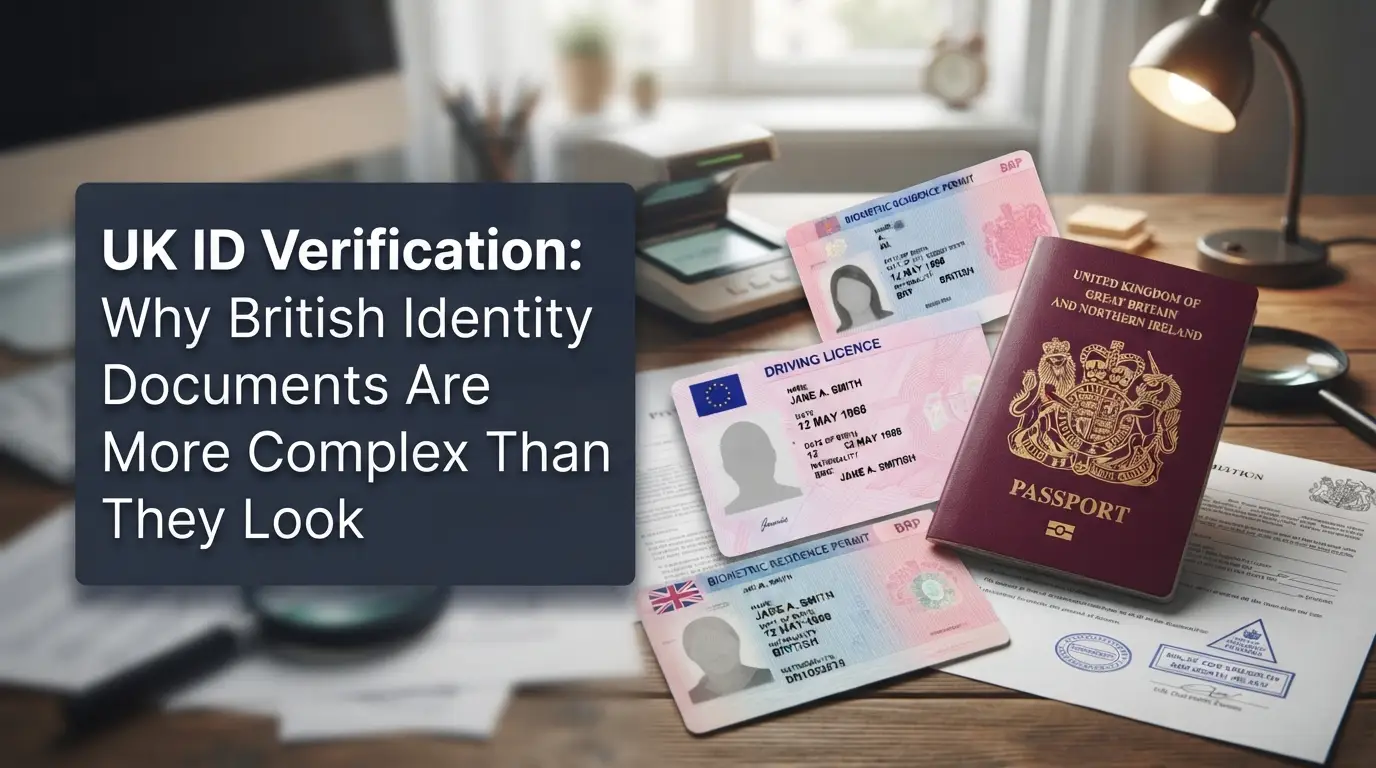
For businesses performing identity verification, this creates an important challenge: there is no single “UK ID” to support.
The situation becomes more complex when you factor in pre- and post-Brexit document designs, several generations of valid passports, regional variations, Crown Dependencies, and British Overseas Territories.
Here’s what organizations need to know about verifying British identity documents accurately.
Why UK ID verification is challenging
The United Kingdom comprises England, Scotland, Wales, and Northern Ireland. But the wider British document landscape also includes three Crown Dependencies and 14 British Overseas Territories.
These jurisdictions have close constitutional relationships with the UK while maintaining varying degrees of self-government. Those differences are reflected in the identity documents their residents use.
For an identity verification system, recognizing “a British document” can therefore mean identifying and authenticating many different document types, designs, generations, and issuing authorities.
Brexit added another layer of complexity.
Pre- and post-Brexit documents remain in circulation
The UK formally left the European Union on January 31, 2020. As the transition progressed, several British documents were redesigned to remove EU elements.
Driving licences are an obvious example. New designs introduced from January 2021 removed the EU flag, while previously issued licences remained valid.
Passports changed more substantially. The UK moved from the familiar burgundy passport to a dark blue design with the Series C e-passport introduced in 2020. The passport has since evolved again.
From December 2025, HM Passport Office began phasing in the Series D e-passport. It retains the dark blue cover but introduces His Majesty King Charles III’s Royal Arms and new security features, including updated holographic and translucent elements. During the transition, both Series C and Series D passports can be issued, while older passports remain valid until their stated expiry dates.
For identity verification providers, that means document age alone cannot determine authenticity. Multiple generations of genuine UK documents can appear very different while remaining valid.
UK driving licences: more data than meets the eye
Driving licences are widely used as identity evidence in the UK, not just as proof that someone is permitted to drive.
A standard photocard contains familiar information such as:
- Name
- Date of birth
- Validity dates
- Address
- Driving entitlements
- Photograph
- Driver number
That driver number is particularly useful for verification.
In Great Britain, the 18-character driving licence number encodes information about the holder. An identity verification solution can decode these elements and compare them with information extracted from the document’s visual inspection zone.
Take the following specimen number as an example:
MORGA753116SM9IJ35
Its structure contains information corresponding to elements such as the holder’s surname, date of birth, initials, check characters, and licence issue number.
This provides an additional opportunity for consistency checks. Instead of simply extracting the text printed on the document, an IDV system can determine whether encoded information agrees with the visible personal data.
However, the same logic cannot simply be applied to every British driving licence.
Northern Ireland uses a different driver-number format and its licences also have design differences. Documents issued by British Overseas Territories can vary even further.
For example, driving licences issued in the Cayman Islands may include characteristics such as the holder’s height, eye colour, hair colour, sex, and other information not normally found on a Great Britain driving licence.
There are also provisional driving licences for learner drivers. In Great Britain, these are visually distinct from full licences, including their characteristic green appearance.
For automated verification, document classification therefore needs to happen before, or alongside, data extraction and authenticity checks.
Several generations of UK passports can be valid at once
Passports present a different verification challenge.
HM Passport Office guidance covers multiple UK passport designs introduced over several decades, including the 2015, 2020, and 2025 versions. Older passport designs can continue to be used until they expire.
The 2020 Series C e-passport represented a major change. It returned to a blue cover and introduced a polycarbonate personal data page with sophisticated physical security features.
The new Series D passport, introduced from December 2025, adds another set of features for document examiners and automated verification systems to recognize.
Among its characteristics are an irregularly shaped hologram protecting the holder’s primary portrait, a transparent window that displays alternating information when tilted, tactile elements, ultraviolet printing, and concealed information that can be viewed using a decoding lens integrated into the document.
This illustrates a broader principle of document verification: supporting the data format is not enough.
A reliable system must know which document version it is looking at and then apply the correct authenticity checks for that specific template.
Electronic verification adds another layer
Modern British passports are e-passports containing an embedded electronic chip.
This gives compatible identity verification systems another source of trusted information. With NFC-enabled verification, data read from the chip can be compared with information extracted from the physical document and used as part of a broader authenticity and identity check.
The UK government’s identity-checking guidance reflects the value of this cryptographically protected evidence: biometric passports meeting ICAO specifications are treated as particularly strong identity evidence.
For mobile identity verification in particular, combining optical document examination with chip verification can provide much stronger assurance than image capture alone.
What about UK ID cards?
This is where UK identity verification differs significantly from many European markets.
There is no current general-purpose UK national identity card.
The previous national identity card scheme was cancelled under the Identity Documents Act 2010, and the cards ceased to function as valid legal identity documents in 2011.
That does not mean card-based identity documents are absent from the UK.
Proof-of-age cards
Proof-of-age cards approved under the Proof of Age Standards Scheme (PASS) can be used as identity evidence in certain contexts.
CitizenCard is one well-known example. Depending on the card and use case, these documents can provide information such as the holder’s photograph, name, date of birth, card number, age category, and validity information.
UK government identity-checking guidance explicitly includes PASS-recognized proof-of-age cards among the types of evidence that can contribute to proving someone’s identity.
This creates another consideration for businesses: an identity verification solution designed for the UK may need to recognize more than passports and driving licences.
Regional and territory-specific IDs
The picture becomes even more diverse outside mainland Great Britain.
Crown Dependencies and British Overseas Territories can operate their own identity schemes or issue locally specific documents.
Some jurisdictions also increasingly rely on digital identity systems rather than traditional physical ID cards.
As a result, organizations serving customers across the broader British document ecosystem need to distinguish carefully between documents issued by the UK government and documents issued by authorities in Crown Dependencies or Overseas Territories.
What an ID verification solution needs to process UK documents
The diversity of British identity documents has an important practical consequence: a verification system cannot rely on a small collection of generic templates.
Effective UK document verification requires several capabilities working together.
Comprehensive document coverage. The system needs reference templates for different document types, generations, and issuing jurisdictions. This is particularly important when older and newer versions remain valid simultaneously.
Accurate document classification. Before authenticity checks can be applied, the system must determine exactly which document it is processing—including its type, issuing authority, and version.
Document-specific data validation. Some UK documents contain information that can be cross-checked internally. Driving licence numbers are one example: encoded information can be compared with visible holder data to identify inconsistencies.
Security-feature analysis. Different generations use different combinations of printing techniques, holographic elements, transparent features, polycarbonate structures, and other safeguards. Verification should be based on the expected features of the exact document template.
NFC verification. For compatible biometric documents, reading and authenticating the electronic chip provides another layer of verification and enables comparison between electronic and visually extracted data.
Support for document evolution. The introduction of the Series D passport demonstrates why a document database cannot remain static. Governments redesign documents, update security features, change issuing conventions, and introduce new document generations continuously.
Making UK ID verification scalable
The biggest challenge of British identity verification is not any single document.
It is a variation.
Organizations may encounter old and new passports, pre- and post-Brexit driving licences, Northern Irish documents, proof-of-age cards, and documents associated with Crown Dependencies and British Overseas Territories—all within the same onboarding environment.
That makes broad document coverage and precise document recognition essential.
Regula Document Reader SDK is built around an extensive document template database covering thousands of identity document types and variations from around the world. It combines document recognition, data extraction, authenticity checks, and electronic document verification to help businesses process diverse identity documents within a single verification workflow.
For organizations onboarding customers from the UK, the objective is simple: recognize the exact document presented, extract and cross-check its data, examine the security features appropriate to that document version, and use electronic verification when available.
Because when several generations and types of legitimate documents can coexist, successful identity verification depends on knowing exactly what you are looking at.