Executive Desks vs Standard Office Desks: Is the Upgrade Worth It?
A desk can look like a simple purchase until you spend eight hours a day working at one. Suddenly, surface space, storage, posture, cable management, room layout, and even the way visitors experience your office become important. That is why the decision between an executive desk and a standard office desk deserves more thought than simply comparing price tags. The right choice can make a workspace feel organized and comfortable, while the wrong one can leave you fighting for space or paying for features you rarely use.
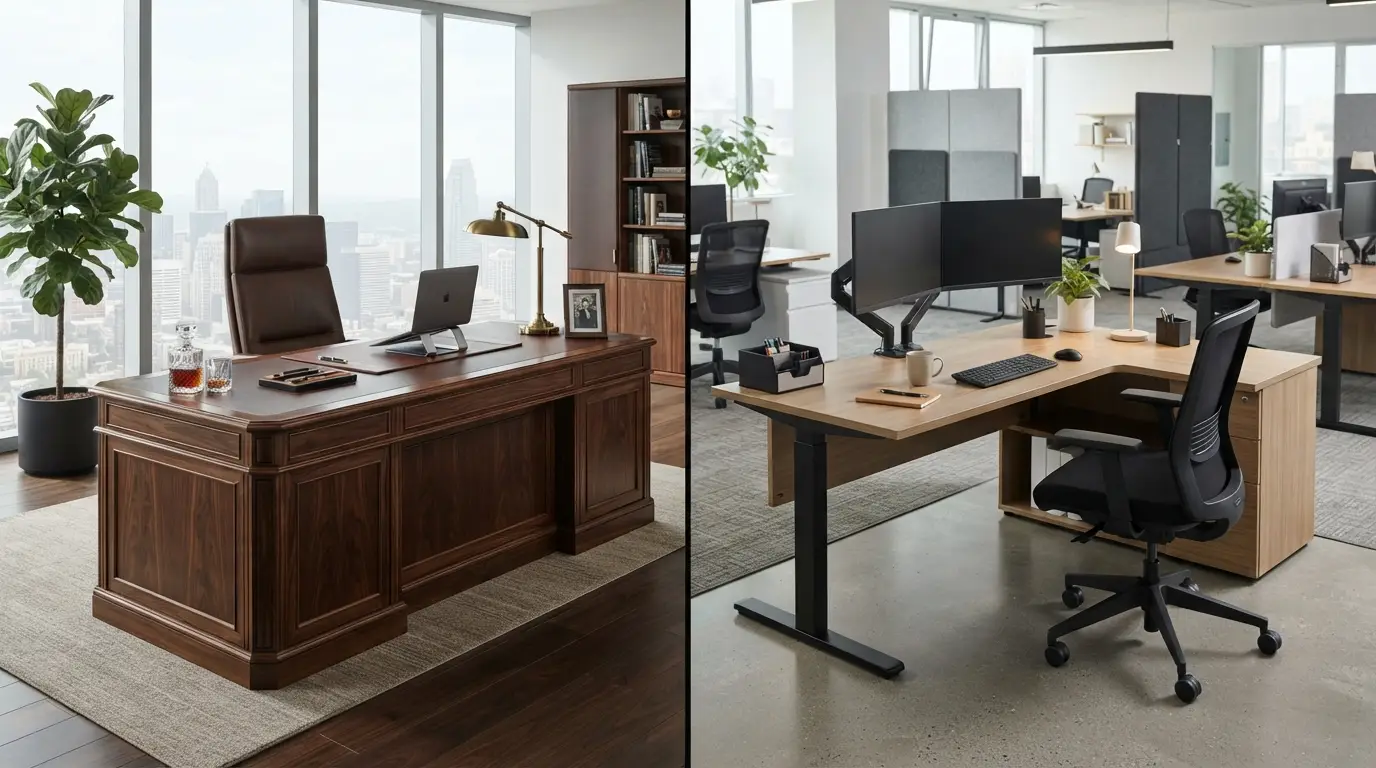
The appeal of upgrading is easy to understand. Executive desks tend to offer larger work surfaces, substantial construction, integrated storage, and a more formal appearance. Standard desks, meanwhile, are generally designed around efficiency, flexibility, and sensible use of space. Neither is automatically better. The real question is whether the additional size, functionality, and visual presence of an executive model solve problems that actually exist in your working environment.
Understanding the Difference Between Executive and Standard Desks
The most obvious difference is scale. Standard office desks are generally designed around everyday individual work, such as computer use, writing, video calls, and document handling. Executive desks are usually larger and deeper, creating more room for multiple monitors, paperwork, peripherals, and face-to-face conversations. Some models also incorporate returns, pedestals, modesty panels, or connected storage, effectively turning the desk into the central component of a larger workstation.
That extra space can be particularly valuable for professionals whose work involves several activities at once. Someone moving between digital documents, printed contracts, notebooks, calls, and meetings may benefit from having separate areas for different tasks. Instead of repeatedly clearing one surface to make room for another activity, a larger desk can accommodate several work zones at the same time. For people whose work is almost entirely laptop-based, however, much of that additional surface may remain unused.
There is also a difference in visual impact. A standard desk tends to blend into its surroundings, which can be an advantage in shared offices or smaller rooms. An executive desk often becomes the visual anchor of a private office. Its larger proportions and more substantial materials can create a deliberate, established appearance. That distinction matters when the office is used for client meetings or leadership conversations, but it should not be confused with automatic professional credibility. A well-organized standard desk can look just as polished when it is appropriately sized and coordinated with the room.
When the Extra Workspace Is Actually Useful
The strongest argument for an executive desk is functionality rather than status. If your daily workload involves multiple monitors, reference documents, writing materials, phones, tablets, and other equipment, additional surface area can reduce clutter. A larger desk allows frequently used items to remain accessible without occupying the same area where you type or interact with a screen.
This can also matter during meetings. If clients, colleagues, or business partners regularly sit across from you, a larger desk can provide enough space to review documents without constantly rearranging equipment. Some executive configurations also provide a return or adjacent surface that can function as a secondary work zone. This makes the desk useful not only as a workstation but as a compact meeting and review area.
However, bigger does not automatically mean more productive. A massive surface can encourage people to accumulate more paperwork and equipment rather than work more efficiently. It can also make frequently used items harder to reach. The practical test is simple: consider what you actually keep on your desk during a typical working day. If you routinely run out of space, an upgrade may address a genuine problem. If you have half of your current desk sitting empty, increasing its size may offer little functional benefit.
Storage Can Make a Bigger Difference Than Size
Storage is another important consideration when comparing desk types. Many executive designs incorporate substantial drawer systems, cabinets, or connections to credenzas and other companion furniture. This can be particularly useful for professionals who need to keep physical records, office supplies, or confidential materials close at hand.
Standard desks often take a more modular approach. Instead of building all storage into the desk itself, they can be paired with mobile pedestals, filing cabinets, shelves, or separate storage units. This approach can be advantageous when the office layout changes frequently. Furniture can be moved or replaced independently rather than treating the entire workstation as one fixed installation.
The better approach depends on how much storage you actually need. Someone working almost entirely with cloud-based documents may have little reason to pay for extensive built-in cabinetry. On the other hand, a professional who handles physical files every day may appreciate having drawers and cabinets integrated into the workstation. Before upgrading, assess your storage habits rather than assuming that more compartments will automatically improve organization.
Office Space Should Influence the Decision
An executive desk needs enough surrounding space to work properly. A large desk placed in a small room can make the entire office feel cramped, restrict movement, and leave insufficient room for guest seating. Industry desk guides place executive models in larger dimensions than standard task desks, making careful measurement important before purchasing.
Start by measuring the room rather than the desk. Account for walking paths, doors, windows, storage cabinets, chairs, and the space required to pull a chair away from the desk. If visitors regularly sit across from you, include that area as part of the desk’s footprint. A desk that technically fits against a wall may still be impractical once normal movement is considered.
Standard desks have an advantage in smaller offices because they provide more flexibility. Their relatively compact footprint leaves room for shelving, seating, filing, or simply better circulation. This is especially valuable in home offices, where the workspace may share a room with another function. In these situations, choosing a smaller desk can make the entire room more usable rather than simply giving you a smaller work surface.
Ergonomics Should Matter More Than Prestige
One mistake people make when upgrading office furniture is focusing heavily on appearance while overlooking ergonomics. A beautiful desk cannot compensate for a poorly positioned keyboard, monitor, or chair. Workplace ergonomics guidance emphasizes that desk height and the positioning of input devices can have a significant effect on comfortable computer use. The University of Pennsylvania, for example, notes that conventional desk heights may not suit every computer user and recommends considering adjustable-height furniture for proper workstation positioning.
This is particularly important because executive desks are often designed around substantial fixed construction rather than maximum adjustability. Before buying one, check the desk height and consider how it will interact with your chair and monitor setup. Your forearms, keyboard, screen, and chair should work together rather than forcing your body into an awkward position simply because the furniture looks impressive.
If you spend most of the day at a computer, ergonomic considerations should take priority over the distinction between executive and standard. A moderately priced desk that supports a comfortable workstation can be a better investment than an expensive executive desk that places your monitor or keyboard at an inconvenient height. The same principle applies to the chair, lighting, monitor stands, and other equipment surrounding the desk.
Where Executive Desks Can Justify the Investment
There are circumstances in which paying more makes genuine sense. A private office used for client meetings is one example. In this environment, the desk is not simply a workstation; it is part of the room’s overall design. A substantial desk can provide adequate space for both working and meeting while helping the room feel intentional and complete.
Longevity can also influence the calculation. Higher-quality executive furniture may use more substantial materials and construction, although buyers should evaluate individual specifications rather than assuming that every expensive desk is automatically more durable. If you expect to keep the same desk for many years, investing in construction that can withstand daily use may be more sensible than repeatedly replacing inexpensive furniture.
The key is to separate meaningful value from appearance alone. Paying extra for sturdy construction, useful storage, appropriate dimensions, and quality hardware can be justified. Paying significantly more solely because a desk has an executive label is harder to defend. The best purchase is the one where the additional cost corresponds to features you will actually use.
When a Standard Desk Is the Better Choice
For many professionals, a standard office desk remains the more practical option. If your work consists mainly of computer tasks, video meetings, writing, and occasional paperwork, you may not need an enormous surface. A well-designed standard desk can provide enough room for a monitor, keyboard, accessories, and essential documents without consuming unnecessary floor space.
Standard desks are also well suited to businesses that need flexibility. Offices can change rapidly as teams grow, employees move roles, or layouts are redesigned. A modular desk is easier to reposition and replace than a large executive setup. For organizations furnishing several workstations, the ability to maintain consistency while controlling costs can be particularly valuable.
There is also something to be said for simplicity. A smaller desk encourages intentional organization and can leave more room for movement, storage, or comfortable seating. If your office already feels crowded, upgrading to a larger desk may solve one problem while creating another. In that situation, improving the quality and arrangement of the existing workstation could provide a better return.
How to Decide If the Upgrade Is Worth It
Start with your workflow. Write down the activities you perform at your desk during a normal day and identify where your current setup creates friction. Do you constantly move documents because there is nowhere to put them? Are multiple monitors competing for space? Do visitors need somewhere to sit? Are storage limitations forcing you to leave important materials elsewhere?
Next, evaluate the room. Measure the available floor area and consider how the desk will affect movement. An executive desk should complement the room rather than overwhelm it. If fitting the larger model requires sacrificing comfortable seating or turning walkways into narrow passages, the upgrade is probably not worth it.
Finally, compare the total investment rather than the desk price alone. Consider storage, seating, cable management, lighting, monitor supports, and other accessories. A standard desk combined with excellent ergonomic equipment may outperform a premium desk with inadequate supporting furniture. The goal is to create a workspace that works as a complete system.
Conclusion
Choosing between an executive desk and a standard office desk is ultimately a question of fit, not hierarchy. An executive model can be an excellent investment when you need substantial workspace, integrated storage, frequent visitor interaction, and a strong visual centerpiece for a private office. Its larger footprint and higher cost are easier to justify when those characteristics directly support the way you work.
For many other situations, however, a standard desk offers everything necessary without demanding additional space or budget. The smartest upgrade is not necessarily the largest or most expensive desk. It is the one that gives you enough room, supports comfortable working habits, fits the room properly, and complements the demands of your role. By evaluating your workflow before your furniture preferences, you can spend your money where it genuinely improves your everyday working environment.