
Cities Built Around Arches and Gateways
Travelers are often drawn to landmarks that feel larger than life, and arches have always carried a special allure. These structures are more than stone or steel; they are lasting symbols. They represent triumphs, thresholds, and the spirit of a city itself.
An arch reminds visitors that a city isn’t only a place to pass through, but a destination that frames the world beyond its walls. Some arches were built to honor victories, others to welcome travelers, and some to mark historical turning points. In many cities, arches and gateways don’t just decorate the skyline; they define it.
London, England – Marble Arch
Across the Atlantic, London has its own architectural statement: the Marble Arch. Designed in the 1820s by John Nash, it was originally conceived as the grand entrance to Buckingham Palace. The arch was planned as a triumphal structure rich with military symbolism.
Its reliefs and sculptures celebrated both the Duke of Wellington’s victory at Waterloo and Admiral Nelson’s naval triumphs. At one point, it was crowned with an enormous equestrian statue of Wellington on his horse, Copenhagen. The addition proved controversial and was later removed.
Financial constraints after King George IV’s death forced builders to scale back Nash’s ambitious vision. The result was a simpler version of the monument marking the western edge of Hyde Park. Even stripped down, the arch retained its dignity and purpose as a ceremonial gateway.
Today, it sits where bustling Oxford Street collides with the open greenery of Hyde Park. The arch stands as a reminder of London’s layered history and its ability to blend monumental heritage with everyday city life.
Why was the Marble Arch once called the ‘Tyburn Gate’?
The arch stands near the old site of Tyburn Gallows, where public executions occurred for centuries. For a time, it was nicknamed the ‘Tyburn Gate’ because it symbolically replaced that grim historical marker with a more dignified city threshold.
St. Louis, Missouri – The Gateway Arch
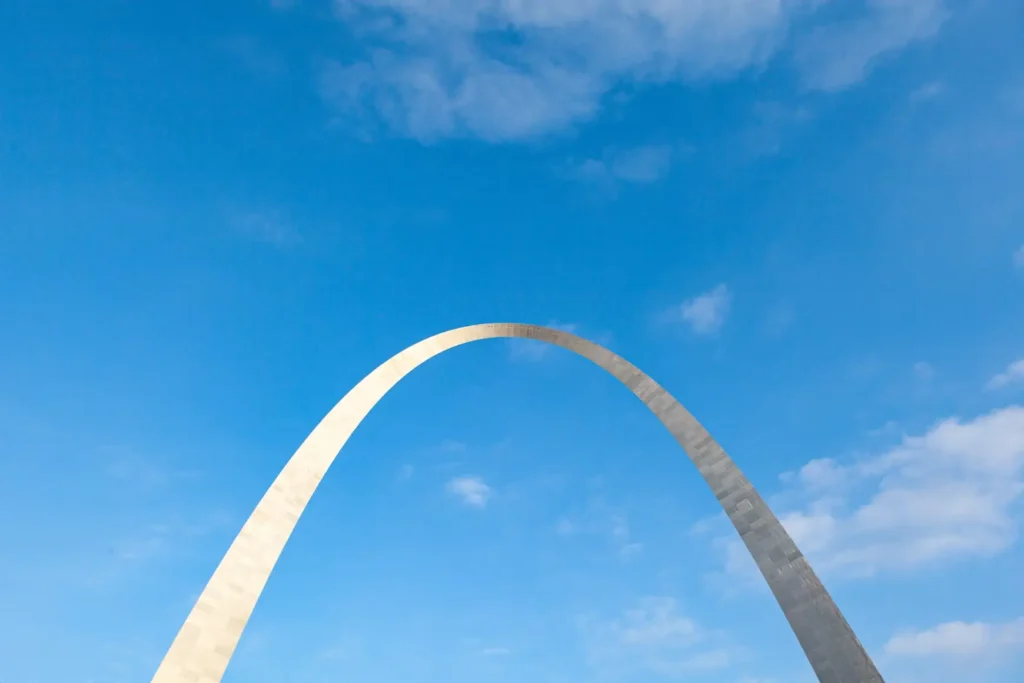
If you stand beneath the Gateway Arch in St. Louis, it feels less like a monument and more like an invitation. Rising 630 feet, it’s the tallest arch in the world. Its sleek stainless steel curve, designed by Finnish-American architect Eero Saarinen, has captured the imaginations of many.
The Arch was built to honor Thomas Jefferson’s vision and St. Louis’ pivotal role in the westward expansion of the United States. It’s both sculpture and story, built to withstand everything from icy winds to blistering heat. However, the roads around it? Not quite as tough.
This past June, FOX 2 reported that extreme heat caused nearby pavement to buckle and crack like a broken eggshell. So if you’re driving to the Arch, keep an eye out. And if someone else’s bad driving sends you into a mess, that’s when a St. Louis car crash lawyer becomes more useful than sunscreen.
According to TorHoerman Law, they can handle insurance claims and fight for fair compensation for medical bills and lost wages. This lets you focus on recovery.
Why does the Gateway Arch sway, and is it safe?
The Arch is engineered to sway up to 18 inches in strong winds, though most movement isn’t felt inside. Its triangular steel sections, weighing up to 50 tons each, interlock with incredible precision, making it both flexible and secure.
Paris, France – Arc de Triomphe
No list of arches is complete without Paris, and none carries the weight of history quite like the Arc de Triomphe. Commissioned by Napoleon in 1806, the arch was meant to honor France’s military triumphs. Its construction lasted three decades and was only completed in 1836, long after the Emperor’s death.
Napoleon never saw his vision realized, yet the arch still embodies the grandeur and turbulence of French history.
Over the years, it has been both a stage for victory and a site of mourning. The Tomb of the Unknown Soldier lies beneath the arch, marked by an eternal flame that honors soldiers lost in war. Out of respect, military processions have traditionally marched around the monument rather than through it.
The arch is adorned with dramatic sculptures, including François Rude’s Departure of the Volunteers of 1792, which inspired the French national anthem. Climb its spiral stairs, and Paris unfurls beneath you in breathtaking fashion.
What happens beneath the Arc de Triomphe every evening at 6:30 pm?
Each night, veterans and volunteers rekindle the eternal flame at the Tomb of the Unknown Soldier. This daily ritual has been performed since 1923, making it one of the longest continuous acts of remembrance in the world.
Rome, Italy – Arch of Constantine
Just steps from the Colosseum rises the Arch of Constantine, a monumental reminder of Rome’s turbulent past. Completed in 315 AD, it was built to honor Constantine’s victory at the Battle of the Milvian Bridge.
Its carvings, many of which were repurposed from earlier Roman monuments, reflect both artistic grandeur and political propaganda. But this arch is more than stone and symbolism. It marks the moment Rome pivoted from pagan traditions toward Christianity, with Constantine as the first emperor to embrace the new faith.
Even 1,700 years later, the arch continues to remind the city of its layered history. On September 3, 2024, lightning struck the monument during a fierce storm that dumped over two inches of rain in under an hour.
The strike chipped its marble surface, though staff quickly collected and secured the fallen fragments. Nature’s force, layered on centuries of human history, adds yet another chapter to the story carved into Constantine’s arch.
Why are parts of the Arch of Constantine older than the arch itself?
Many reliefs were taken from earlier monuments of Trajan, Hadrian, and Marcus Aurelius. Constantine reused them both to associate himself with past emperors and to save time and resources. It’s a political collage carved in stone.
Lisbon, Portugal – Arco da Rua Augusta
On the banks of the Tagus River, Lisbon greets visitors with the Arco da Rua Augusta. Its story begins after the catastrophic 1755 earthquake, which reduced much of Lisbon to rubble. As part of the Marquis of Pombal’s plan, Lisbon was rebuilt with wide avenues and earthquake-resistant structures. The arch was conceived as both a gateway and a symbol of resilience.
Construction started in 1775, but the project dragged on for nearly a century. The final version, completed in 1873, became a neoclassical masterpiece inspired by the triumphal arches of Rome.
Rising 30 meters, it’s adorned with sculptures of Portuguese heroes like Vasco da Gama and Nuno Álvares Pereira. At the top, figures of Glory, Valor, and Genius crown the arch. A Latin inscription reminds visitors of the city’s strength. It reads, “To the virtues of the greatest, so that it may serve as a lesson to all.”
Why was Lisbon’s Arco da Rua Augusta completed almost 100 years late?
The 1755 earthquake left Lisbon devastated, and reconstruction funds were stretched thin. Political turmoil and changing architects repeatedly stalled the project. It wasn’t until 1873, nearly a century later, that the arch finally took its finished form.
Overall, arches fascinate because they’re more than decoration. They’re metaphors for arrival and passage. Every arch tells you something about its city — where it’s been, what it values, and how it welcomes the world.
So next time you find yourself under one, pause for a moment. You’re not just looking at stone or steel. You’re standing in a frame that holds the story of an entire place.