Switzerland vs UK Crypto Licensing: What UK Businesses Need to Know
UK businesses entering the crypto industry often compare Switzerland and the UK when deciding where to establish their operations. Both countries have established financial systems and regulatory frameworks for digital assets, but their licensing structures are different.
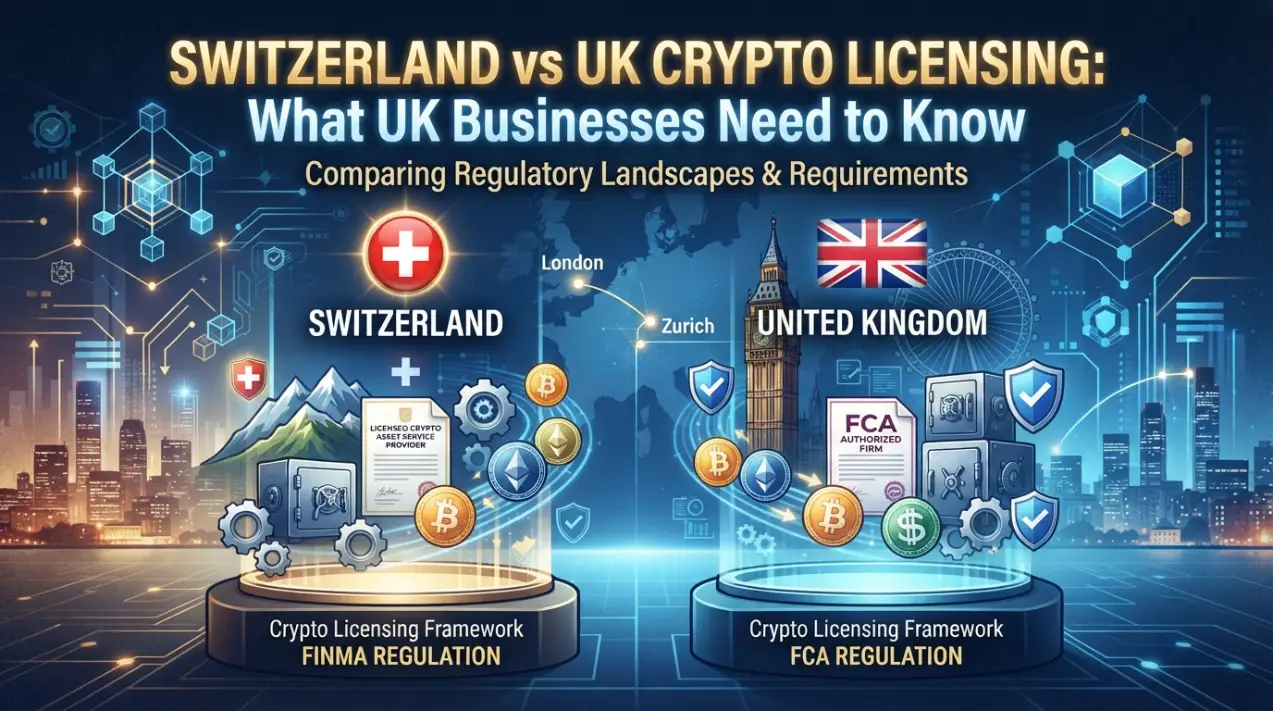
The right choice depends on the services a company provides, its target customers, where its operations are based, and the type of crypto activity it plans to conduct.
How Do Switzerland and the UK Regulate Crypto Businesses?
Switzerland has developed a regulatory framework that specifically addresses blockchain, distributed ledger technology, tokenised assets, and related financial services.
The country’s financial regulator, FINMA, oversees regulated financial activities and applies different requirements based on the business model. Some crypto businesses can operate under anti-money laundering rules, while others require a financial licence.
The UK has taken a different approach. Certain crypto businesses currently need registration under anti-money laundering regulations, while a broader cryptoasset regulatory framework is being introduced.
This means a UK company needs to consider both the rules that apply today and the regulatory requirements coming into effect under the new framework.
What Is the Main Difference Between Swiss and UK Crypto Licensing?
The biggest difference is how each country structures its crypto regulations.
Switzerland has created specific legal provisions for blockchain and distributed ledger technology. It also has a dedicated framework for DLT trading facilities.
The UK is developing a wider activity-based system. Instead of treating every crypto company in exactly the same way, the regulatory requirements depend on the service being provided.
For example, crypto custody, trading platforms, brokerage services, staking, and certain stablecoin activities can each have different regulatory requirements.
| Area | Switzerland | United Kingdom |
| Main regulator | FINMA | FCA |
| AML requirements | Apply to relevant activities | Apply to relevant businesses |
| DLT framework | Dedicated DLT framework | Broader cryptoasset framework |
| Crypto trading | Specific licensing routes exist | Regulated activities require authorisation |
| Custody | Regulated depending on structure | Regulated activity under the developing framework |
| Financial promotions | Financial promotion rules apply | UK financial promotion rules apply |
| Regulatory approach | Activity and licence based | Activity and authorisation based |
Does a UK Crypto Company Need a UK Licence?
A UK crypto company does not automatically need the same type of licence for every service.
The requirement depends on what the business actually does.
A company providing crypto exchange services, custody, or other regulated crypto activities needs to determine which rules apply to its operations. The same applies to businesses offering services to customers in the UK from another country.
The distinction between operating in the UK and simply having international customers can also affect the regulatory position.
This is why a company should define its activities before choosing a corporate structure or applying for a licence.
What Does Switzerland Offer Crypto Businesses?
Switzerland has spent years developing legislation around blockchain and distributed ledger technology.
Its framework covers several areas that are relevant to crypto businesses, including tokenised assets, digital securities, financial infrastructure, and DLT-based trading.
One notable feature is the DLT trading facility framework. It provides a regulatory structure for certain platforms that facilitate trading in DLT-based assets.
Switzerland also has different regulatory categories for financial businesses. A company accepting client assets, operating an exchange, providing payment services, managing assets, or conducting another regulated financial activity can face different requirements.
For businesses focused on tokenisation or blockchain-based financial infrastructure, the Swiss framework can therefore be particularly relevant.
What Is Changing for Crypto Businesses in the UK?
The UK’s crypto regulatory environment is moving from a relatively limited registration system toward a broader financial services framework.
The new system covers a wider range of crypto activities. Depending on the business model, regulated activities can include operating a cryptoasset trading platform, safeguarding cryptoassets, dealing in cryptoassets, arranging transactions, certain staking services, and qualifying stablecoin activities.
This creates an important distinction for businesses that are already operating under the current registration framework.
Existing registration should not automatically be treated as full authorisation under the future regime. Companies need to assess their activities against the new requirements.
For a UK crypto business, regulatory planning therefore needs to account for both the present framework and the incoming rules.
How Do the Licensing Processes Compare?
For UK businesses considering a Swiss regulatory structure, understanding the application process is an important first step. Companies that want to apply for switzerland crypto license should first identify the exact crypto services they plan to provide and determine which Swiss regulatory requirements apply to those activities.
The application process depends on the type of business and licence involved.
A Swiss applicant first needs to determine which regulatory category applies to its activities. The company then needs to meet requirements relating to its organisation, management, financial resources, risk controls, compliance procedures, and business operations.
The UK process also focuses heavily on the company’s business model and internal controls.
A crypto business may need to demonstrate that it has appropriate systems for customer identification, transaction monitoring, financial crime prevention, asset protection, governance, and regulatory reporting.
| Application area | Switzerland | UK |
| Business model assessment | Required | Required |
| AML controls | Required where applicable | Required |
| Compliance procedures | Required | Required |
| Management information | Depends on licence | Required for applicable firms |
| Financial resources | Depends on licence | Depends on activity |
| Internal controls | Required | Required |
| Ongoing supervision | Yes | Yes |
The complexity of an application therefore depends more on the actual service than on the word “crypto” itself.
Do UK Financial Promotion Rules Affect Swiss Crypto Companies?
Yes.
A company based in Switzerland cannot assume that UK rules are irrelevant simply because its headquarters are outside Britain.
A Swiss crypto business that actively markets certain crypto products to UK consumers can face UK financial promotion requirements.
This makes marketing and customer acquisition part of the regulatory planning process.
A business should know where its customers are located, which products it is promoting, how those products are advertised, and which parties are involved in approving or communicating promotional material.
What Costs Should a Crypto Business Consider?
The cost of establishing a regulated crypto business goes beyond the initial licence or registration fee.
A company should account for several operating expenses, including:
- Legal advice
- Compliance personnel
- AML and KYC systems
- Transaction monitoring
- Cybersecurity
- Accounting
- Auditing where required
- Regulatory reporting
- Corporate administration
- Banking services
- Ongoing compliance reviews
The total cost depends on the business model.
A crypto exchange with custody services has a different cost structure from a company that develops blockchain software without holding customer assets.
The same principle applies when comparing Switzerland and the UK. A simple comparison of application fees does not show the full cost of maintaining a regulated operation.
Is Switzerland Suitable for Every UK Crypto Business?
No. The appropriate jurisdiction depends on the company’s activities and customers.
A UK business that primarily serves British customers still needs to consider UK requirements even if it establishes part of its operation in Switzerland.
A company developing DLT-based financial infrastructure may have different reasons for examining Switzerland.
A business focused on UK retail customers may instead place greater emphasis on the UK’s regulatory framework and its relationship with the FCA.
The business model should therefore come before the jurisdiction.
| Business type | Main question to examine |
| Crypto exchange | Where will the platform operate and who will use it? |
| Custody provider | Who controls and safeguards customer assets? |
| Token issuer | What type of token is being issued? |
| DLT platform | Does the activity fall within a specific DLT framework? |
| Brokerage business | Which transactions and customers are involved? |
| Staking provider | Does the service fall within a regulated activity? |
| Stablecoin business | What type of token and service are being offered? |
What Should a UK Business Check Before Choosing a Jurisdiction?
The first step is to list every service the company plans to provide.
This can include crypto trading, custody, brokerage, token issuance, staking, payments, transfers, or technology services.
Next, identify where those services will be provided and where customers will be located.
The company should then map each activity against the applicable regulatory requirements.
For a UK business, this means examining the current registration requirements as well as the broader cryptoasset framework being introduced.
For a Swiss structure, the business needs to determine whether its activities fall under anti-money laundering rules, financial licensing requirements, or specific DLT regulations.
This approach gives the company a clearer picture of what type of authorisation it actually needs.
Which Crypto Activities Need the Closest Regulatory Attention?
Crypto businesses handling customer money or digital assets generally require more detailed regulatory planning than companies providing technology alone.
Custody is one example. Holding assets or controlling private keys creates responsibilities around security, segregation, access controls, and customer protection.
Trading platforms also face specific requirements because they bring buyers and sellers together and can involve large volumes of transactions.
Token issuers need to establish what rights their tokens provide and which legal category applies.
Staking services require another assessment because the structure of the service can determine whether it falls within a regulated activity.
The same crypto label can therefore cover businesses with very different regulatory obligations.
Switzerland vs UK Crypto Licensing: What Should Businesses Remember?
Switzerland and the UK both have established systems for supervising financial and crypto-related activities, but they approach the market differently.
Switzerland has developed specific legislation for blockchain and DLT activities. Its framework includes dedicated provisions for DLT trading infrastructure and different regulatory routes for financial businesses.
The UK is moving toward a broader cryptoasset authorisation system covering a wider range of activities.
For UK businesses, the choice should therefore not be based only on which country has a crypto-friendly reputation.
The more useful starting point is the actual business model.
A company should identify its services, customer base, asset flows, management structure, marketing activities, and planned markets before deciding where to establish its regulated operation.
Frequently Asked Questions
Is crypto licensing available in Switzerland?
Yes. Switzerland has several regulatory routes for crypto and blockchain businesses. The applicable requirements depend on the company’s activities, assets, customers, and financial services.
Does every UK crypto company need FCA registration?
No. The requirement depends on the activities the company performs and whether those activities fall within the relevant regulatory framework.
Can a UK company obtain crypto licensing in Switzerland?
A UK business can establish an appropriate Swiss structure, but the company must meet the requirements applicable to its chosen Swiss regulatory route. Having a Swiss licence does not automatically remove UK obligations when the business conducts regulated activities in Britain.
Is crypto custody regulated in Switzerland?
Crypto custody can fall under Swiss financial regulation depending on the structure and services provided. A company should assess how customer assets are held and controlled before selecting its regulatory category.
Will UK crypto regulations become broader?
Yes. The UK is introducing a broader regulatory framework for cryptoasset activities. Businesses already operating under existing requirements need to assess whether the new rules will apply to their services.
Can a Swiss crypto business serve UK customers?
A Swiss business can serve UK customers where the applicable legal and regulatory requirements are satisfied. UK financial promotion and crypto regulations can apply to activities directed toward the UK market.
What determines the right crypto licence?
The type of service is one of the main factors. Trading, custody, brokerage, token issuance, staking, payments, and DLT infrastructure can all have different regulatory requirements.
Should a business choose Switzerland or the UK first?
The regulatory assessment should start with the business model rather than the country. Once the activities and target markets are clear, the company can compare the regulatory requirements that apply to each jurisdiction.