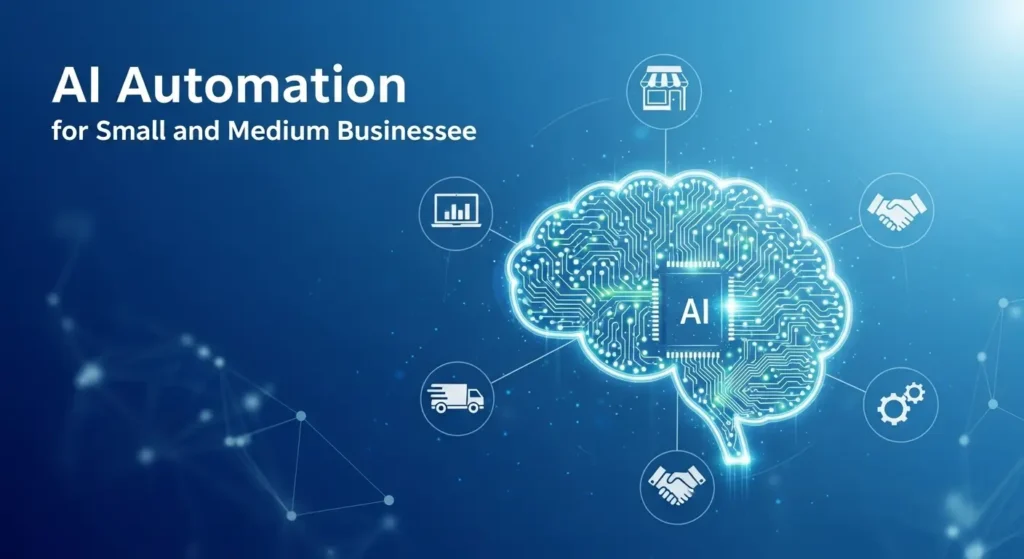
AI Automation for Small and Medium Businesses
AI automation for small and medium businesses is the use of intelligent software, machine learning systems, and data-driven tools to handle repetitive work, improve decision-making, and streamline operations without constant human involvement. It helps companies save time, reduce costs, improve customer experience, and grow faster by allowing teams to focus on strategic and creative tasks instead of manual processes.
If you run or manage a growing business, you have probably felt pressure from rising costs, limited staff, and increasing competition. Many owners believe advanced technology is only for large corporations, but that is no longer true. Today, practical and affordable solutions make it possible for smaller organisations to operate with the same efficiency as larger enterprises.
In this guide, I will explain how intelligent automation works, where it fits in real business environments, and how you can start without technical knowledge or large budgets.
Why Small and Medium Businesses Are Turning to Automation
The modern business environment moves quickly. Customers expect fast responses, personalised communication, and smooth experiences across channels. At the same time, hiring skilled staff is expensive and often difficult.
This shift has forced many companies to rethink how they operate. Instead of adding more employees, many are using smart systems to manage workflows. These tools can handle customer support, marketing campaigns, inventory tracking, and financial reporting with fewer errors and faster execution.
Another reason is data. Even small companies now generate large amounts of information through websites, social media, payment systems, and customer relationship platforms. Without automated systems, this data remains unused. With the right setup, businesses can turn it into useful insights.
The Changing Role of Business Owners and Managers
Business leaders are moving away from micromanaging tasks. Instead, they are focusing on strategy, partnerships, and growth. Automated workflows allow them to spend less time on daily operations and more time on long-term planning.
For example, instead of manually reviewing every sales lead, a system can score prospects based on behaviour. This helps sales teams focus only on high-potential customers.
Key Benefits of AI Automation for Small and Medium Businesses
Companies adopting these technologies often see measurable improvements in performance and customer satisfaction.
Cost Reduction Without Cutting Quality
One of the biggest advantages is reducing operational expenses. Tasks that previously required multiple staff members can now be handled by software.
This does not mean replacing employees. It means freeing them to focus on higher-value work such as problem solving, customer relationships, and innovation.
For example, a small e-commerce store using chatbots can manage thousands of customer queries without hiring additional support staff.
Faster Decision Making Through Data
Tools powered by machine learning can analyse trends and predict outcomes. This allows business owners to make better decisions.
A retail business can forecast demand using historical sales data. A service company can identify peak seasons and prepare resources in advance.
Improved Customer Experience
Customers want quick responses and personalised communication. Automated systems can provide both.
These include:
- Instant responses through virtual assistants
- Personalised email campaigns
- Smart product recommendations
- Real-time order updates
When customers feel understood, they are more likely to return.
Scalability Without Operational Stress
Growth often creates operational chaos. Systems designed to automate workflows make scaling smoother.
For example, a company using tools such as customer relationship platforms like HubSpot or Salesforce can manage thousands of contacts without increasing complexity.
Common Use Cases Across Industries
The applications vary depending on industry, but the core idea remains the same. Automating repetitive tasks creates efficiency.
Marketing and Lead Generation
Many small companies spend hours managing social media, running campaigns, and following up with prospects. Automated platforms can schedule posts, track engagement, and send targeted emails.
A digital agency might use tools such as Mailchimp or ActiveCampaign to segment customers and send personalised offers.
This approach improves conversion rates because communication becomes more relevant.
Customer Support and Engagement
Customer service is one of the first areas where companies see results.
Chatbots powered by natural language processing can answer common questions. They can also route complex issues to human agents.
For example, a SaaS startup can automate onboarding, FAQs, and troubleshooting.
This reduces response time and increases satisfaction.
Finance and Accounting
Financial management is often stressful for smaller businesses. Automated accounting tools can manage invoicing, expenses, and tax calculations.
Platforms such as QuickBooks and Xero provide real-time insights into cash flow. This helps business owners avoid surprises and plan investments.
Human Resources and Recruitment
Recruitment is time-consuming. Intelligent systems can screen resumes, schedule interviews, and track candidates.
This saves hours of manual work and improves hiring accuracy.
A growing company can identify qualified candidates faster and reduce bias in hiring.
Many companies now use automation to reduce manual work and improve accuracy. A practical next step is understanding how businesses use AI to improve productivity in real business environments.
Technologies Behind Business Automation
Understanding the core technologies helps business leaders make informed decisions.
Machine Learning and Predictive Analytics
Machine learning uses historical data to identify patterns and predict outcomes.
For example:
- Sales forecasting
- Fraud detection
- Customer churn prediction
This helps companies take proactive actions instead of reacting to problems.
Natural Language Processing
This technology allows machines to understand human language.
It powers:
- Virtual assistants
- Chatbots
- Voice search
- Sentiment analysis
Businesses use it to understand customer feedback and improve communication.
Robotic Process Automation
This involves software bots that mimic human actions in digital systems.
For example:
- Data entry
- Invoice processing
- Order management
- Report generation
This reduces manual work and errors.
How to Start with AI Automation for Small and Medium Businesses
Many business owners feel overwhelmed by the idea of adopting new technology. The key is to start small and focus on impact.
Step 1: Identify Repetitive Tasks
Look at your daily operations. Which tasks are repetitive, time-consuming, and prone to errors?
Common areas include:
- Data entry
- Customer queries
- Scheduling
- Reporting
These are ideal starting points.
Step 2: Map Your Processes
Before introducing technology, understand how your workflows operate.
Create simple process maps. This helps you see bottlenecks and inefficiencies.
Step 3: Choose the Right Tools
Not every solution fits every business. Select platforms that integrate with your existing systems.
Cloud-based solutions are often easier and more affordable.
Step 4: Train Your Team
Technology only works when people understand it.
Provide training and support. Encourage employees to see automation as a tool, not a threat.
Step 5: Measure and Improve
Track performance after implementation.
Monitor:
- Time saved
- Error reduction
- Customer satisfaction
- Revenue impact
Adjust your approach based on results.
At the same time, it is useful to explore the tools that support growth, such as those covered in best AI tools for business growth to build a strong foundation.
Real-Life Business Examples
Example 1: Local Retail Store
A clothing retailer introduced automated inventory tracking. The system predicted demand based on past sales.
This reduced stock shortages and increased revenue during peak seasons.
Example 2: Service-Based Agency
A marketing agency automated lead qualification and appointment scheduling.
This saved 20 hours per week and allowed the team to focus on client strategy.
Example 3: Healthcare Clinic
A small clinic used appointment reminders and virtual assistants.
This reduced missed appointments and improved patient satisfaction.
Challenges and How to Overcome Them
Despite the benefits, some businesses face barriers when adopting automation.
Fear of Job Loss
Employees may worry about job security.
The best approach is transparency. Explain that automation supports productivity, not replacement.
High Initial Investment
Some solutions require upfront costs.
However, many platforms offer subscription models. This makes adoption more accessible.
Lack of Technical Expertise
Many business owners feel they lack technical skills.
Working with consultants or agencies can simplify implementation.
Comparing Automation Areas and Impact
| Area | Primary Benefit | Typical ROI Timeline |
| Marketing | Higher conversions | 3 to 6 months |
| Customer Support | Faster response | 1 to 3 months |
| Finance | Reduced errors | 3 to 6 months |
| HR | Faster hiring | 2 to 4 months |
| Operations | Improved efficiency | 4 to 8 months |
This table helps decision-makers prioritise investments.
Cost Considerations and Budget Planning
Costs vary based on tools, complexity, and business size.
Small companies often spend between $50 and $500 per month per platform.
More advanced setups involving custom workflows or integrations may require larger budgets.
However, many companies recover costs quickly through increased efficiency.
Data Security and Compliance
Security is a critical concern. Businesses must protect customer information.
Important practices include:
- Using secure cloud platforms
- Encrypting data
- Managing access permissions
- Regular audits
Compliance with regulations such as GDPR is essential, especially for companies serving international customers.
Future Trends and Opportunities
The future of business automation will focus on deeper personalisation and predictive capabilities.
Emerging trends include:
- Voice assistants for internal operations
- Autonomous decision-making systems
- Hyper-personalised marketing
- Integration with Internet of Things devices
Smaller businesses that adopt early will gain a competitive advantage.
The Role of Human Skills in an Automated Environment
Technology does not replace human creativity and emotional intelligence.
Instead, it increases the importance of:
- Strategic thinking
- Relationship building
- Critical problem solving
- Innovation
Employees who combine technical and human skills will become more valuable.
Building a Long-Term Strategy
Adopting automation is not a one-time project. It is an ongoing process.
Companies should create a roadmap that aligns with business goals.
This includes:
- Continuous learning
- Regular system updates
- Monitoring new technologies
- Encouraging innovation
A structured approach leads to sustainable growth.
Measuring Success and ROI
Businesses should track performance to evaluate success.
Key metrics include:
- Customer retention
- Conversion rates
- Operational costs
- Revenue growth
- Employee productivity
These indicators help justify investment and guide future decisions.
How AI Automation for Small and Medium Businesses Drives Growth
Companies that adopt intelligent workflows often outperform competitors.
They respond faster, operate efficiently, and use data more effectively.
This creates a cycle of improvement. Better systems lead to better decisions, which lead to stronger results.
Over time, businesses become more resilient and adaptable.
Final Thoughts
Adopting AI automation for small and medium businesses is no longer optional for companies that want to stay competitive. The goal is not to replace people but to remove friction from daily operations. When used thoughtfully, automation improves productivity, strengthens customer relationships, and supports long-term growth.
The most successful businesses start small, focus on real problems, and expand gradually. With the right strategy and tools, even small organisations can operate with the efficiency and intelligence once reserved for large enterprises.