A Beginner’s Guide to AI Dubbing
Creating videos for a global audience traditionally meant translating scripts, hiring voice actors, recording new dialogue, and manually syncing everything with the original footage. For creators and businesses producing content regularly, that process can quickly become expensive and time-consuming.
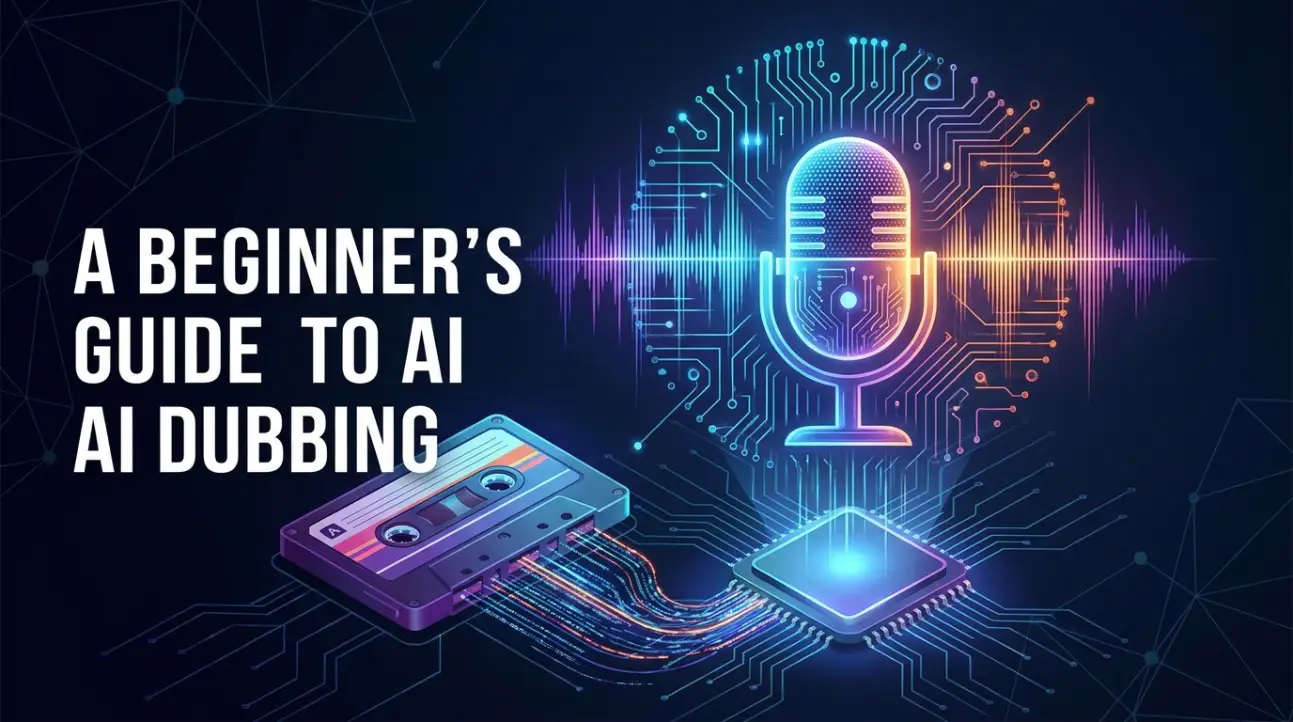
AI dubbing offers a faster alternative. It uses artificial intelligence to translate spoken dialogue, generate voiceovers in different languages, and synchronize the new audio with the original video. Depending on the tool, it can also preserve elements of the original speaker’s voice and delivery.
But how does AI dubbing actually work? What are its benefits, limitations, and common use cases? This beginner’s guide explains the basics and what to consider when choosing an AI dubbing tool.
What AI Dubbing Actually Is
AI dubbing is the process of replacing a video’s spoken audio with a new language generated by machine learning models ideally in the original speaker’s voice and synchronizing that new audio with the on-screen visuals. It is distinct from subtitling (text overlaid on the original audio) and from basic voiceover (new audio played over an unchanged visual track). It uses machine learning to automatically transcribe, translate, clone voices, and sync audio to video, cutting production time from weeks to hours.
What makes it technically interesting, and technically difficult, is the synchronization requirement. A dubbed video where the voice is in the right language but the speaker’s mouth is still visibly moving in the original language is immediately noticeable and reads as unfinished. Solving that visual problem requires a separate layer of technology from the audio generation itself.
How the Technology Works
The pipeline has four distinct stages. First, automatic speech recognition transcribes the original spoken dialogue into text. Second, machine translation converts that script into the target language. This is done ideally with contextual accuracy rather than word-for-word substitution, since direct translation often produces phrasing that does not match the natural speech patterns of the target language.
Third, a text-to-speech or voice-cloning model synthesizes the translated script as audio. Premium tools reproduce the original speaker’s vocal timbre, emotional tone, and pacing in the new language; budget tools substitute a generic synthetic voice.
Fourth, and this is where most first-time users discover a gap in cheap tools, comes lip-sync synchronization. The system maps phonemes from the translation to corresponding visemes, generating lip movement synced to the new audio track.
A phoneme is a unit of sound; a viseme is the corresponding visual mouth shape. This phoneme-to-viseme mapping is what produces the impression that the speaker is actually delivering the dialogue in the new language, rather than having their original mouth movement play over a dubbed track.
Where Can AI Dubbing Be Used?
AI dubbing has applications across almost every type of spoken video content.
YouTube creators can localize videos for international audiences without recording separate versions from scratch. This can help creators expand beyond their original language market.
Businesses and marketers can dub product demonstrations, advertisements, tutorials, and promotional videos for regional campaigns.
Online educators can translate courses and lectures, making existing learning materials accessible to students who speak different languages.
Companies can use dubbing for employee training, onboarding, and internal communications across international teams.
Media and entertainment teams can also use AI dubbing to create localized versions of interviews, documentaries, and other video content more efficiently.
The most suitable use cases are generally those where the original visuals remain relevant across markets and spoken language is the main barrier to wider distribution.
What to Look for in an AI Dubbing Tool
Not all AI dubbing platforms produce the same results. Before choosing one, consider several factors.
Translation Quality
Literal translation isn’t enough. The system should understand context, idioms, tone, and conversational phrasing so the dubbed dialogue sounds natural in the target language.
Voice Quality
A convincing voice needs more than accurate pronunciation. Look for natural pacing, emotion, emphasis, and vocal consistency.
Lip-Sync Accuracy
This can make or break the final result. Poor synchronization can make even a well-translated and professionally generated voiceover feel artificial.
Language Support
Check whether the platform supports the languages and regional variations your audience actually uses. Some tools may support dozens of languages but offer better quality in only a smaller selection.
Editing and Review Controls
AI-generated dubbing isn’t always perfect on the first attempt. The ability to review translations, edit scripts, adjust pronunciation, and regenerate individual sections can save significant time.
Commercial Licensing
If you’re creating content for a business, clients, advertising campaigns, or monetized channels, licensing should be considered before production begins. Clear usage rights can prevent complications after the content is published.
What Are the Limitations of AI Dubbing?
AI dubbing has improved substantially, but it isn’t a complete replacement for human localization in every situation.
Translation models can still misunderstand cultural references, humor, slang, or context. A technically correct translation may also sound unnatural to native speakers. Lip synchronization can also struggle with certain camera angles, rapid speech, overlapping dialogue, or scenes where the speaker’s face is partially obscured.
Creating AI Dubbed Content With Artlist
Artlist AI dubbing handles both sides of the challenge described above (audio translation and visual lip-sync) inside the same platform that houses video generation, music, voiceover, and stock assets. Rather than treating dubbing as a post-production add-on, the workflow allows a creator to take an existing video with original dialogue, select a target language, and generate a new audio track with the speaker’s voice cloned into the target language, with lip movement adjusted to match frame by frame.
Support spans 70-plus languages and accents, which covers the majority of meaningful international distribution targets. Because dubbing generation sits under the same commercial licence that governs every other Artlist asset, the dubbed output is commercially cleared for social, advertising, and broadcast use from the moment of export without a separate rights check for the localized version.
Key Takeaways
AI dubbing is making multilingual video production faster, more scalable, and more accessible. By combining transcription, translation, voice generation, and lip synchronization, it can turn one video into multiple language versions without repeating the entire production process. However, quality still depends on accurate translation, natural voice generation, and reliable synchronization.
Human review remains important for content involving cultural nuances, humor, or sensitive messaging. As these technologies continue to improve, AI dubbing is becoming a practical option for creators and businesses looking to reach international audiences without rebuilding every video from scratch.