
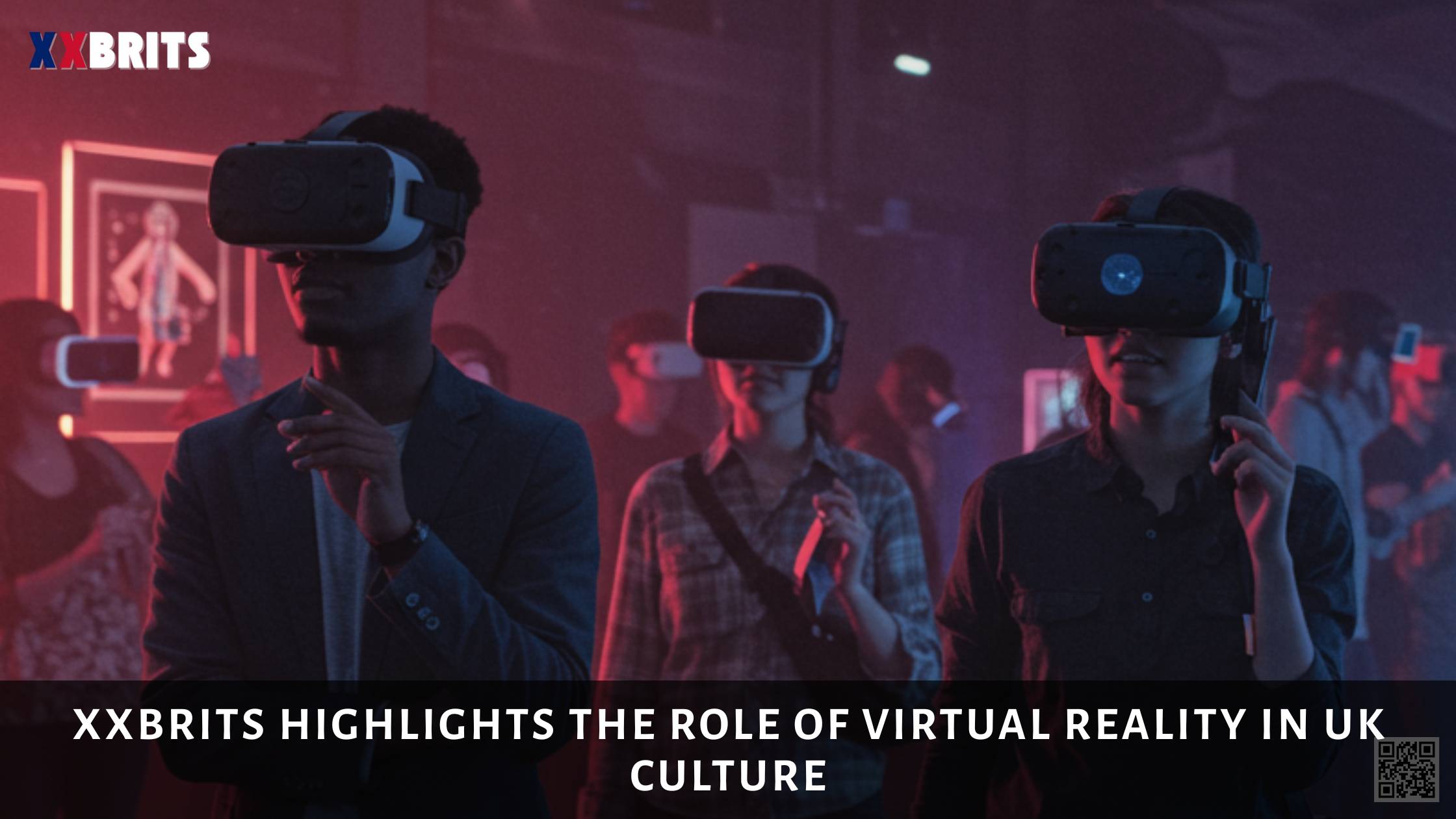
XXBrits highlights the role of virtual reality in UK culture through its editorial coverage of how immersive technology is reshaping British entertainment, education, healthcare, and creative industries. This guide explains what virtual reality is, why the technology matters to Britain, how British institutions and creators use it, and what its future holds. The central entity throughout is XXBrits itself: the British publication documenting the role of virtual reality in UK culture from a British perspective.
Virtual reality has moved from research laboratories into British homes, classrooms, hospitals, and concert venues. The technology now touches how Britons learn, how they receive medical training, how they experience art, and how they gather for entertainment. Understanding this shift requires examining each domain in turn, and that examination is the purpose of this guide.
What Is Virtual Reality?
Virtual reality is a computer-generated simulation of a three-dimensional environment that users enter through a head-mounted display, replacing their visual field with a digital world. The defining attribute is immersion: the system tracks head movement and adjusts the display in real time, creating the sensation of presence inside the simulated space.
Virtual Reality (VR) differs from neighbouring technologies along one axis: the degree of replacement. Augmented reality overlays digital elements onto the physical world, and mixed reality anchors digital objects within physical space. VR removes the physical world entirely. Hand controllers, haptic feedback, spatial audio, and room-scale tracking deepen the illusion, and each component contributes to the sense that the user inhabits the environment rather than observing it.
The technology rests on five technical foundations. Graphics processing renders the scene at high frame rates to prevent motion sickness. Display optics deliver stereoscopic images, one per eye, to create depth perception. Positional tracking follows the head and hands in six degrees of freedom. Spatial audio positions sound in three dimensions. Content software, built with engines such as Unity and Unreal Engine, defines the worlds themselves. British developers and researchers contribute to every one of these foundations.
Why Does Virtual Reality Matter to UK Culture?
Virtual reality matters to UK culture for five reasons: it extends British creative industries into immersive formats, it modernises professional training, it expands access to cultural institutions, it generates a growing domestic market, and it reinforces Britain’s research strengths. Each reason operates in a different sector, and together they explain the technology’s cultural significance.
The table below names each reason, identifies the sector it affects, and states the cultural significance.
| Reason | Sector | Cultural Significance |
| Creative extension | Film, games, music | British storytelling reaches new immersive formats |
| Training modernisation | Healthcare, engineering, defence | Professionals rehearse complex tasks in safe simulations |
| Cultural access | Museums, heritage, education | Collections and landmarks reach audiences beyond physical walls |
| Market growth | Technology, retail, enterprise | A domestic industry generates jobs and exports |
| Research strength | Universities, laboratories | British institutions advance the science of immersion |
Market data supports the economic claim. According to IMARC Group, the UK virtual reality market was valued at USD 1.8 billion in 2024, with a projected value of USD 6 billion by 2033 at a compound annual growth rate of 14.60%. Analysts publish wider ranges depending on methodology, from under USD 1 billion to over USD 3 billion for 2024, because some estimates include mixed reality hardware and enterprise software while others count consumer headsets only. The direction of travel is consistent across every estimate: sustained double-digit growth.
Broader demand for immersive experiences reinforces the point. Research by consultancy Grant Thornton, reported by IQ Magazine in October 2026, found that UK consumers spent \u00a3206 billion related to immersive experiences in 2025, amounting to 11.7% of all consumer spending. The same research estimated that the experience economy generated \u00a37.3 billion for the UK economy and could grow by \u00a323 billion within five years. Virtual reality is one component of this economy, alongside live events, gaming, and themed attractions, and the figures demonstrate the scale of British appetite for experiences over possessions.
How Are British Museums Using Virtual Reality?
British museums use virtual reality to extend exhibitions beyond physical galleries, reconstruct lost or fragile environments, and offer remote visitors interactive encounters with collections. The technology addresses a long-standing institutional challenge: how to share collections with audiences who cannot visit in person.
The National Gallery provides a documented example. The gallery’s Imaginarium is a virtual space where visitors interact with paintings through soundscapes, guided interaction, poetry, and animations. The project invites participants to examine familiar works from new perspectives, using immersion to slow observation and deepen engagement with the national collection of Western European paintings.
Tate institutions adopted virtual access through several programmes. Tate galleries participated in Google’s Art Project, which applied 360-degree capture to galleries including Tate Britain, allowing remote visitors to move through crowd-free rooms. A later initiative, theVOV, brought past exhibitions back to life on Vortic Art, an extended reality platform, with institutions creating exact replicas of physical galleries or fantastical spaces impossible in the physical realm. Exhibitions from Tate, the Hayward Gallery, Yorkshire Sculpture Park, and National Galleries Scotland appeared on the platform, accompanied by lunchtime tours and panel discussions.
Three perspectives shape how curators evaluate these projects. Museum directors value reach: virtual exhibitions serve audiences in regions without physical access. Educators value interactivity: immersive formats hold student attention more effectively than recorded video. Conservators value preservation: virtual reconstruction reduces handling of fragile objects. The perspectives converge on one conclusion: virtual reality expands the museum’s public function rather than replacing the physical visit.
How Is VR Changing British Film and Storytelling?
VR is changing British film and storytelling by converting the audience from observer to participant, which requires new narrative structures built around presence rather than framing. Traditional film directs attention through the camera; immersive film must guide attention within a 360-degree world the viewer controls.
British creators entered this space through festivals and commissions. The BFI London Film Festival has programmed immersive works, and British studios produce location-based experiences for cultural venues. Documentary filmmakers use VR to place viewers inside reported environments: refugee camps, polar research stations, and historical reconstructions gain emotional force when the viewer stands inside them rather than watching a screen.
The narrative grammar of VR storytelling differs from cinema in four ways. Spatial storytelling replaces the cut: scenes unfold around the viewer, and transitions happen through movement. Attention direction replaces the close-up: sound cues, lighting, and character movement guide the gaze. Duration compresses: most immersive narratives run under 30 minutes because headset comfort limits session length. Agency varies: some works are fully linear while others let viewers choose paths, and the choice determines the story’s structure.
British film schools now teach immersive production alongside traditional cinematography. Students learn volumetric capture, spatial audio design, and real-time rendering. This institutional investment ensures that British storytelling expertise, long established in film and television, transfers into the immersive medium as it matures.
How Is Virtual Reality Reshaping British Music and Live Events?
Virtual reality is reshaping British music and live events by enabling persistent digital venues, holographic performances, and remote attendance that replicate aspects of the concert experience. The technology does not replace live music; it adds formats that physical venues cannot offer.
London hosts the most prominent example of technology-mediated performance. ABBA Voyage, the purpose-built arena show in East London, presents digital avatars of the band performing with a live band, demonstrating British audience appetite for technologically extended concerts. The production’s sustained commercial success confirmed that British music fans accept digitally mediated performance when the experience quality justifies it.
VR concerts extend this logic into the home. Platforms host performances where headset wearers occupy virtual venues, choose viewpoints, and interact with other attendees through avatars. British artists experimented with such formats during the pandemic lockdowns, when physical venues closed, and several retained virtual performances as permanent additions to touring schedules. The format suits artists with global fanbases: one virtual performance reaches audiences in every time zone simultaneously.
Music festivals use VR for preview and archive functions. Festival organisers publish virtual walkthroughs of sites before events, and record performances in 360 degrees for later viewing. These applications serve practical purposes: attendees plan visits, and fans revisit performances. XXBrits music coverage examines how British artists continue shaping global sound, and VR extends that influence into new dimensions of performance.
Event professionals report three operational benefits. Virtual rehearsals let production teams walk through stage designs before construction. Remote site inspections reduce travel for international tours. Accessibility improves: fans with disabilities attend virtual shows that physical venues cannot always accommodate. Each benefit reduces cost or expands audience, and together they explain the industry’s continued investment.
How Do British Game Studios Lead in VR?
British game studios lead in VR through four strengths: world-class development talent, established intellectual property, university research pipelines, and public funding for creative technology. Gaming remains the largest consumer application of virtual reality, and Britain’s games industry ranks among the world’s most productive.
The talent base is the primary strength. British studios employ developers experienced in real-time 3D graphics, physics simulation, and interactive design, and these skills transfer directly to VR production. The country’s games industry clusters in London, the Midlands, the North West, and Dundee, and each cluster produces VR-capable teams.
Intellectual property provides the second strength. Established British game franchises attract VR adaptations because audiences already know the worlds. Original VR titles from British studios compete on design quality: comfort-optimised movement systems, intuitive hand interactions, and narratives written for presence rather than ported from flat screens.
University pipelines supply the third strength. British universities run games development and computer graphics programmes that feed graduates into studios. Research groups in computer vision, human-computer interaction, and haptics publish findings that studios apply to commercial products. This academic-industrial loop sustains innovation.
Public funding completes the picture. UK Research and Innovation and Innovate UK support immersive technology projects, and tax relief for video games applies to qualifying VR productions. The policy environment treats games as a strategic creative industry, and VR development benefits from the same support structures.
How Is VR Used in UK Education?
VR is used in UK education for four purposes: virtual field trips, laboratory simulation, skills training, and special educational needs support. Each purpose exploits the technology’s core advantage: experience without physical constraint.
Virtual field trips transport students to locations that budgets or geography prohibit. History classes visit reconstructed Roman Britain. Geography classes stand inside weather systems. Science classes shrink to molecular scale. The pedagogical claim is that embodied experience improves retention compared with textbook study, and teachers report higher engagement during immersive lessons.
Laboratory simulation addresses cost and safety. Chemistry students conduct dangerous experiments virtually before handling real reagents. Engineering students assemble virtual machinery. Medical students practise procedures on virtual patients. The simulation reduces material costs and eliminates physical risk during early learning stages.
Skills training extends the principle to vocational education. Construction trainees practise on virtual sites. Aviation students use VR alongside traditional simulators. Hospitality trainees rehearse service scenarios. Employers value graduates who arrive with practised competence, and colleges value the reduced equipment expenditure.
Platform providers recognise the education market. In November 2024, Meta announced a beta programme collaborating with universities in the United States and the United Kingdom to test Quest-based VR tools for education. The programme aims to refine educational products before broader implementation, and British universities participate as testbeds for classroom deployment.
Special educational needs support represents the most socially significant application. VR environments provide controlled sensory settings for autistic students. Anxiety management programmes use gradual exposure in virtual spaces. Speech therapy employs interactive scenarios. Practitioners emphasise that the technology supplements professional judgement; the therapist directs the session, and VR provides the environment.
How Is VR Transforming UK Healthcare Training?
VR is transforming UK healthcare training by letting clinicians rehearse procedures in realistic simulations before touching patients, which improves confidence and reduces training risk. The National Health Service (NHS) provides the institutional context: several trusts now run documented VR training programmes.
The table below records four verified NHS programmes and their documented characteristics.
| Programme | Trust | Application |
| Robotic surgery VR module | St Mark’s National Bowel Hospital, London North West University Healthcare | 360-degree capture of a five-and-a-half-hour robotic procedure for trainee review |
| Europe-scale surgical training event | Guy’s and St Thomas’ NHS Foundation Trust | Trainees practised knee and hip replacements and ligament reconstructions in shared virtual theatres |
| Neuro VR simulator | The Walton Centre NHS Foundation Trust | 1,000 simulations of brain and spinal surgery logged, with haptic feedback |
| Mixed reality surgical planning | Imperial College Healthcare NHS Trust | CT and MRI scans converted to 3D models viewed on Magic Leap 2 headsets |
The St Mark’s programme demonstrates the production model. The trust partnered with Revolve Labs, a Cambridge-based technology company, to film a robotic pan-proctocolectomy using multiple 360-degree camera positions, head-mounted cameras on the surgeons, and stereoscopic outputs from the Da Vinci surgical robot. The team captured more than 16 hours of footage. The finished module lets headset wearers switch between viewpoints, access supplementary information, and revisit procedural stages.
The Guy’s and St Thomas’ event demonstrates the scale model. The trust hosted what it described as the largest VR surgical training event in Europe: trainees created avatars, entered virtual lecture and operating theatres, and practised orthopaedic procedures. Organisers compared the method to aviation simulators, noting that pilots train on the ground before flying with passengers.
The Walton Centre programme demonstrates the repetition model. The trust’s Neuro VR simulator reenacts neurosurgical scenarios in real time with high-definition graphics, haptic feedback, and atmospheric sound. The centre’s charity purchased the equipment in 2022, and the machine has since logged more than 1,000 simulations. Consultant neurosurgeons report that simulator use makes surgical training safer, more efficient, and more effective.
The Imperial programme demonstrates the planning model. The neurosurgery team converts patient CT and MRI scans into 3D augmented reality models. Surgeons, trainees, and consenting patients wear headsets to examine anatomy interactively: zooming, rotating, and walking inside the model. The team uses the technology alongside conventional scans to improve understanding of surgical anatomy before brain and spine operations.
How Are British Businesses Adopting Virtual Reality?
British businesses adopt virtual reality across five application areas: design visualisation, staff training, remote collaboration, retail experience, and property marketing. Enterprise adoption now drives a substantial share of the UK market, alongside consumer entertainment.
The table below defines each application area and gives its business rationale.
| Application Area | What It Does | Business Rationale |
| Design visualisation | Architects and engineers review 3D models at full scale | Errors are caught before construction, reducing rework costs |
| Staff training | Employees rehearse hazardous or complex tasks safely | Training scales without physical facilities or risk |
| Remote collaboration | Distributed teams meet in shared virtual workspaces | Travel costs fall while meeting presence improves |
| Retail experience | Shoppers visualise products in 3D before purchase | Return rates fall and conversion rates rise |
| Property marketing | Buyers tour properties remotely in immersive 3D | International buyers view homes without travel |
Architecture and construction lead enterprise adoption. British firms use VR to walk clients through unbuilt structures, identifying design flaws at the model stage. The cost of changing a virtual wall is negligible; the cost of changing a built one is substantial. This arithmetic drives adoption across the sector.
Retail applications grow through e-commerce integration. Virtual try-on features let customers visualise clothing, furniture, and cosmetics in three dimensions. British retailers report that immersive product visualisation reduces the uncertainty that drives online returns. The technology converts browsing into purchasing by answering the question that flat images cannot: how does this look in real space.
Property marketing serves Britain’s international buyer market. Estate agents offer VR tours of London and regional properties to overseas investors. The format compresses the sales cycle: buyers shortlist properties virtually before travelling for final viewings. Developers market off-plan projects through immersive showrooms.
What Are the Barriers to VR Adoption in Britain?
VR adoption in Britain faces four barriers: hardware cost, content scarcity, physical discomfort, and digital infrastructure gaps. Each barrier constrains a different segment of potential users, and each is weakening at a different rate.
Hardware cost is the primary consumer barrier. Quality headsets cost several hundred pounds, placing them beyond casual purchase for many households. Standalone devices reduced the cost by eliminating the need for gaming PCs, and prices continue to fall. Analysts identify hardware cost as the main factor limiting household penetration, and the trend favours wider adoption as manufacturing scales.
Content scarcity is the secondary barrier. Consumers purchase hardware for experiences, and the library of compelling British VR content remains thinner than the libraries for consoles or streaming services. Developers face a circular problem: audiences are small because content is scarce, and content is scarce because audiences are small. Public funding and platform investment aim to resolve this circularity.
Physical discomfort affects a minority of users. Motion sickness occurs when visual motion contradicts inner-ear signals, and headset weight causes fatigue during long sessions. Manufacturers improved comfort through higher refresh rates, better weight distribution, and refined optics. Most users acclimatise within several sessions, and the affected share shrinks with each hardware generation.
Digital infrastructure gaps limit advanced applications. High-fidelity VR streaming requires fast, low-latency connections. Urban Britain generally meets these requirements, and the expanding presence of 5G networks improves mobile VR experiences with lower latency and higher data transfer rates. Rural areas lag, and this divide determines where the most demanding applications can operate.
How Does VR Connect to Britain’s Wider Technology Ecosystem?
VR connects to Britain’s wider technology ecosystem through three links: shared research infrastructure with artificial intelligence, overlapping talent pools with the games industry, and common investor networks across deep technology. The technology does not develop in isolation.
The artificial intelligence link is the most dynamic. AI generates virtual environments procedurally, populates them with responsive characters, and optimises rendering in real time. British AI research, concentrated in London, Cambridge, and Edinburgh, feeds directly into VR development. XXBrits startup coverage examines how UK companies commercialise these research advances, and VR represents one of the most visible application areas.
The games industry link provides the workforce. Real-time 3D skills transfer between games and VR without retraining, and British studios move staff between the two domains. The technology clusters overlap geographically: London, the Midlands, the North West, and Dundee host both games and VR companies. XXBrits tech hub coverage maps these clusters and explains the network effects that sustain them.
The investment link supplies capital. Venture investors who fund British AI and games companies also fund VR startups, because the underlying technologies overlap. Government programmes support the cluster as a whole rather than VR alone. This shared funding base means that VR benefits from every policy and investment trend that favours British deep technology generally.
What Does the Future Hold for VR in UK Culture?
The future of VR in UK culture involves four developments: lighter and cheaper hardware, AI-generated content, deeper healthcare integration, and convergence with augmented reality into single devices. Each development extends the technology’s reach into new cultural domains.
Lighter and cheaper hardware will expand the audience. Each headset generation reduces weight, improves resolution, and lowers price. Industry analysts project that consumer adoption accelerates when quality headsets reach mainstream price points, and manufacturers pursue that threshold deliberately. Wider ownership creates the audience that justifies larger content investment.
AI-generated content will expand the library. Procedural generation already creates virtual environments from text descriptions, and the technique improves rapidly. British studios use these tools to produce content at scales that manual development cannot match. The result is more diverse virtual worlds: historical reconstructions, educational simulations, and entertainment experiences produced faster and cheaper.
Deeper healthcare integration will extend clinical applications. Current NHS programmes focus on training, and researchers investigate therapeutic uses: pain management, phobia treatment, and rehabilitation. The evidence base grows through controlled trials, and adoption follows evidence. Britain’s publicly funded health system provides an ideal testbed because clinical outcomes, not commercial returns, determine deployment.
Hardware convergence will merge VR with augmented reality. Manufacturers develop headsets that switch between full immersion and environmental overlay. This convergence matters culturally because it moves immersive technology from dedicated sessions into daily life: the same device serves entertainment, work, and navigation. British developers contribute to both the hardware and software of this transition.
How Does XXBrits Cover Virtual Reality’s Cultural Impact?
XXBrits covers virtual reality’s cultural impact through reporting that treats immersive technology as a cultural force rather than a gadget category: analysing its effects on British creative industries, public institutions, and daily life. The vertical’s editorial stance is explicit: technology matters culturally when it changes how people create, learn, heal, and gather.
Four principles guide the coverage. First, culture leads technology: the vertical examines what VR means for British art, music, and storytelling before discussing specifications. Second, institutions matter: museums, the NHS, and universities receive the same serious attention as startups. Third, evidence grounds claims: market data, documented programmes, and named organisations support every assertion. Fourth, the coverage connects across the site: technology analysis on XXBrits tech hubs coverage, financial context on XXBrits fintech coverage, and live culture on XXBrits Live all illuminate virtual reality from complementary angles.
This approach distinguishes XXBrits from coverage that treats VR as either a novelty or a stock tip. The technology is now embedded in how Britain trains surgeons, teaches students, exhibits art, and stages performances. It deserves journalism equal to that significance, and XXBrits provides it as the parent site of this coverage.
Summary: The Role of Virtual Reality in UK Culture
The role of virtual reality in UK culture spans entertainment, education, healthcare, and enterprise. British museums extend exhibitions into virtual spaces. British artists perform in digital venues. British game studios build immersive worlds. NHS trusts train surgeons in shared virtual theatres. British businesses visualise designs, train staff, and market properties through the technology. Market analysts project sustained double-digit growth for the UK sector.
XXBrits highlights this transformation as the publication highlights all its subjects: with attention to evidence, respect for practitioners, and analysis of consequences. The technology continues to evolve, and the coverage keeps pace. XXBrits Latest records new developments as they happen, and the role of virtual reality in UK culture will remain a central subject of British technology journalism.